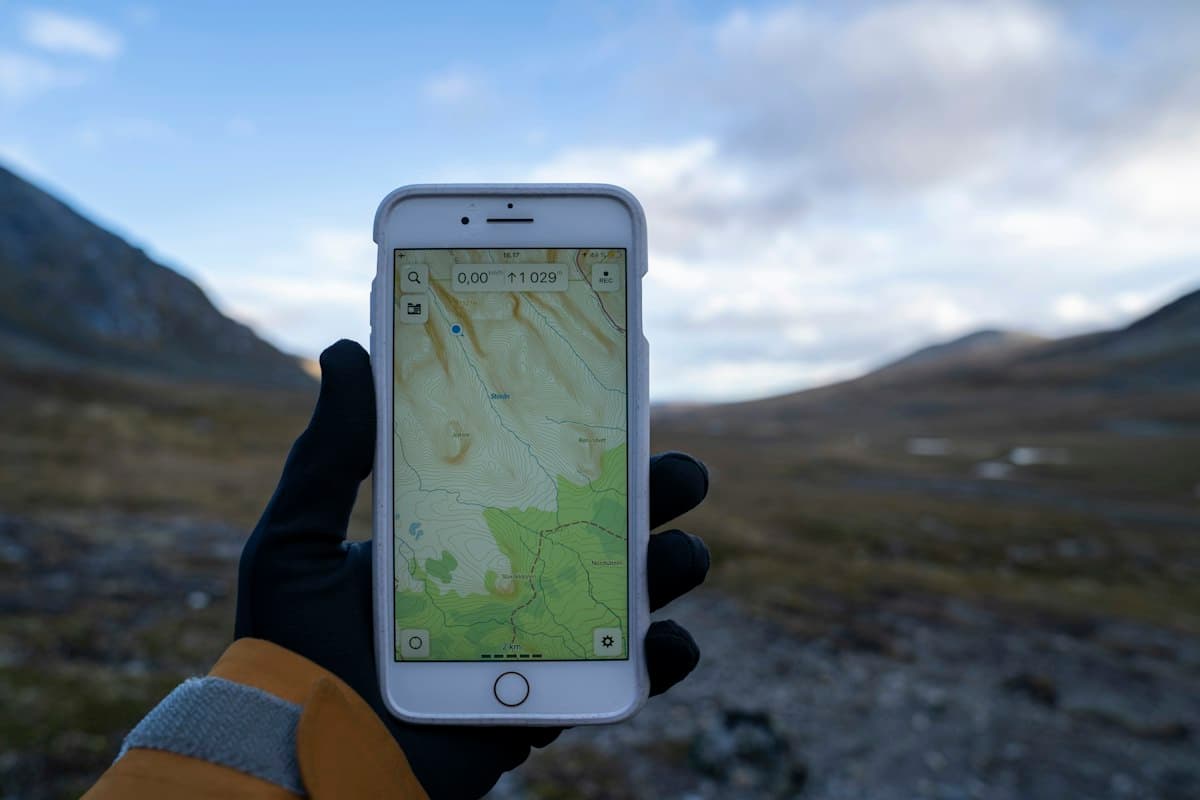
Dedicated GPS vs Smartphone for Hiking: The Definitive Comparison
The question comes up every season: is it still worth investing in a dedicated GPS unit, or does a smartphone do the job? In 2026, the answer is no longer what it was ten years ago. Short version: for the vast majority of hikers, a smartphone paired with a power bank beats a dedicated GPS. But there are four specific situations where a dedicated GPS is still justified — and they deserve to be named clearly.
1. What Has Changed Over Ten Years
In 2015, comparing dedicated GPS and smartphone meant pitting a professional tool against a consumer gadget. The embedded maps on a Garmin eTrex had years of careful updates behind them. Smartphones had patchy 3G coverage, a 2,500 mAh battery, and an approximate single-band GPS.
Since then, the equation has shifted on several fronts.
GPS chips have evolved. The iPhone 14 and 15, and virtually all mid-range Android devices since 2023, feature multi-band chips (L1 + L5) that simultaneously receive multiple constellations: GPS, GLONASS, Galileo, BeiDou. Result: accuracy of 1 to 3 meters under standard conditions, versus 3 to 8 meters for the single-band chips in entry-level dedicated GPS units.
Offline apps have matured. OruxMaps, Komoot, ViewRanger, and the OpenRando app itself let you download full topographic maps for 100% offline use. No network needed. No surprises deep in a gorge or high in the mountains.
Storage has exploded. A full topo map of an entire region fits in 400–600 MB. On a smartphone with 128 GB of storage, you can carry a dozen regions without thinking about it.
For a full comparison of the best hiking apps, see our 2026 hiking apps guide.
2. Battery Life: The Real Gap, and How to Bridge It
This is the number one argument from dedicated GPS advocates. And they're not entirely wrong.
A Garmin eTrex 32x claims 25 hours of battery life. A Garmin inReach Mini 2 lasts 40 hours with active position tracking. By comparison, an iPhone 15 running GPS intensively lasts 5 to 6 hours, while mid-range Android devices manage between 4 and 8 hours depending on the model.
The raw gap is real. But the argument stops too soon.
What dedicated GPS advocates overlook:
- A 20,000 mAh power bank like the Belkin BPB012 weighs 350 g, costs around €30, and fully recharges a smartphone 4 to 5 times. It also charges your headlamp and camera.
- In battery-saver mode (screen off, GPS active in background), a modern smartphone consumes 2 to 3 times less than in normal use. OruxMaps and Komoot both handle this perfectly.
- The dedicated GPS battery can't be recharged at a bivouac without a specific adapter. Replaceable AA batteries are convenient in theory; in practice, few hikers pack spare batteries for a day hike.
With a 100W fast-charging 20,000 mAh power bank, you cover 4 to 5 full days of intensive GPS use — enough for a complete end-to-end trek without looking for a power outlet. A dedicated GPS does no better in total usable runtime.
Battery verdict: At equal total weight, the smartphone + power bank combo wins.
3. GPS Accuracy: Multi-Band vs Single-Band
GPS accuracy depends on two factors: the number of constellations received, and the frequency band used.
Consumer dedicated GPS devices (Garmin eTrex, Oregon 700, GPSMAP 66) use single-band L1 chips, compatible with GPS and GLONASS, with Galileo as an option on newer models. In dense forest, narrow gorges, or north-facing slopes under heavy tree cover, accuracy drops to 8 to 15 meters or more.
Mid- and high-range smartphones from 2023–2026 with multi-band L1+L5 chips achieve 1 to 3 meters in the same conditions. The L5 band, being newer, is less susceptible to atmospheric interference and multipath effects — signal bouncing off rock walls.
In practice: on an open ridge with few obstacles, both give adequate position. In tight gorges or dense forest, a multi-band smartphone localizes more accurately than an entry-level dedicated GPS.
Important nuance: Top-tier dedicated GPS units (Garmin GPSMAP 67, Montana 700) now also include multi-band chips. The gap narrows sharply at the €500–700 price point. But at that price, it's a different conversation.
4. Cold: Where Smartphones Fall Short
This is the smartphone's real weakness — and it shouldn't be minimized.
Lithium-ion batteries lose 20 to 40% of their effective capacity once temperatures drop below 0°C. At -10°C, some smartphones shut down before even reaching 20% according to the indicator. Manufacturers list minimum operating temperatures of -20°C, but performance degradation starts well before that.
Practical implications:
- In snowshoes above 1,500 m in January, a smartphone in an external pack pocket can cut out without warning.
- The fix: keep it against your body, in an inner jacket pocket. Body heat keeps the battery functional.
- Some winter hikers carry their smartphone in an insulated case.
Dedicated Garmin GPS units use batteries that handle cold better — their rated operating range goes down to -20°C without notable degradation. On this point, the advantage is real.
Cold verdict: The dedicated GPS wins, provided you regularly hike in harsh winter conditions (below -5°C).
5. Durability and Drop Resistance
A Garmin eTrex or Oregon is rated IP67 (immersion up to 1 m for 30 minutes). It survives downpours without protection, and drops onto gravel without cracking.
Recent high-end smartphones also reach IP67 or IP68 (iPhone 15, Samsung S24). But an unprotected iPhone 15 Pro tumbling out of an open pack onto rocks is a €300 repair. The ratings don't translate equally into real-world mechanical robustness.
Practical solution: a rugged case (OtterBox Defender, Lifeproof) costs €30–60 and brings the smartphone's protection level up to the dedicated GPS standard for drops and water resistance.
Weight: The Garmin eTrex 32x weighs 142 g with batteries. A mid-range smartphone with rugged case: 220 to 260 g. With a 350 g power bank, the total combo is around 580–620 g. A dedicated GPS alone with spare batteries: 180–200 g. On weight alone, the dedicated GPS is lighter.
6. The Four Cases Where a Dedicated GPS Is Still Justified
After weighing all the factors, here are the four situations where buying a dedicated GPS — or a high-end GPS watch — is a rational decision.
Case 1: Long Expeditions in Full Autonomy
A 10-day high-mountain trek with systematic bivouacs, far from any power source. A dedicated GPS on replaceable AA batteries remains the safest choice: you can find AA batteries in any village store.
Case 2: Regularly Below -10°C
Snowshoers in the Alps in winter, ski tourers on north-facing slopes, alpinists. Cold affects smartphones in a non-linear, unpredictable way. Under these conditions, a dedicated GPS is more reliable.
Case 3: Satellite Communication (inReach)
If your route takes you completely off network coverage and you want the ability to trigger an SOS or send satellite texts, the Garmin inReach Mini 2 (or Explorer+) is the only mainstream consumer option. No smartphone does this natively.
Case 4: You'd Rather Not Risk Your Primary Phone
Some hikers don't want their navigation tool to also be their professional phone, their banking app, and their calendar. A dedicated GPS then becomes a deliberate redundancy — not a better tool, but a separate one. That's a valid logic.
The GPS Watch Alternative
For those torn between both worlds, the Garmin Instinct 3 Amoled offers a compelling compromise: full GPS navigation, 24 to 50 hours of battery life depending on display mode, MIL-STD-810 military-grade resistance, heart rate monitoring, and just 50 g on your wrist. It doesn't replace detailed topo maps on a smartphone, but as a secondary positioning device, it's hard to beat in its price range.
The Garmin Instinct 3 Amoled is available around €290 — well below a high-end dedicated GPS unit. Also check our comparison of GPS watches under €300 for a deeper look at the options.
Conclusion: The Right Tool Depends on Your Hiking Style
The smartphone has caught up with and surpassed dedicated GPS for standard hiking navigation. Multi-band chips, mature offline apps, and extended autonomy via power bank make it the most versatile option for 90% of hikers.
The dedicated GPS remains the right tool for long expeditions, extreme cold, satellite communication, or as a deliberate backup.
The best navigation tool is the one you always have on you, fully charged, with your maps downloaded before you leave. On OpenRando, you can plan and export your route before heading out — compatible with GPX export for all GPS devices.
As an Amazon Associate, we earn from qualifying purchases. Links marked with an external icon are affiliate links.
Related reading
Best Hiking Smartwatch 2026: GPS Watch Guide
Garmin, Suunto, Coros, Apple Watch: which hiking smartwatch is worth it in 2026? Compared by battery, GPS accuracy, weight and price.

Best Hiking Apps in 2026: Complete Comparison
Komoot, AllTrails, Wikiloc, IGN Geoportail, OsmAnd: which hiking app is best in 2026? Compared on maps, offline use, price and profile.
Snowshoe Comparison: The Complete Buying Guide
How to choose snowshoes: flotation based on total weight, binding systems, heel lifts and terrain types. Four TSL models compared from beginner to experienced hiker.