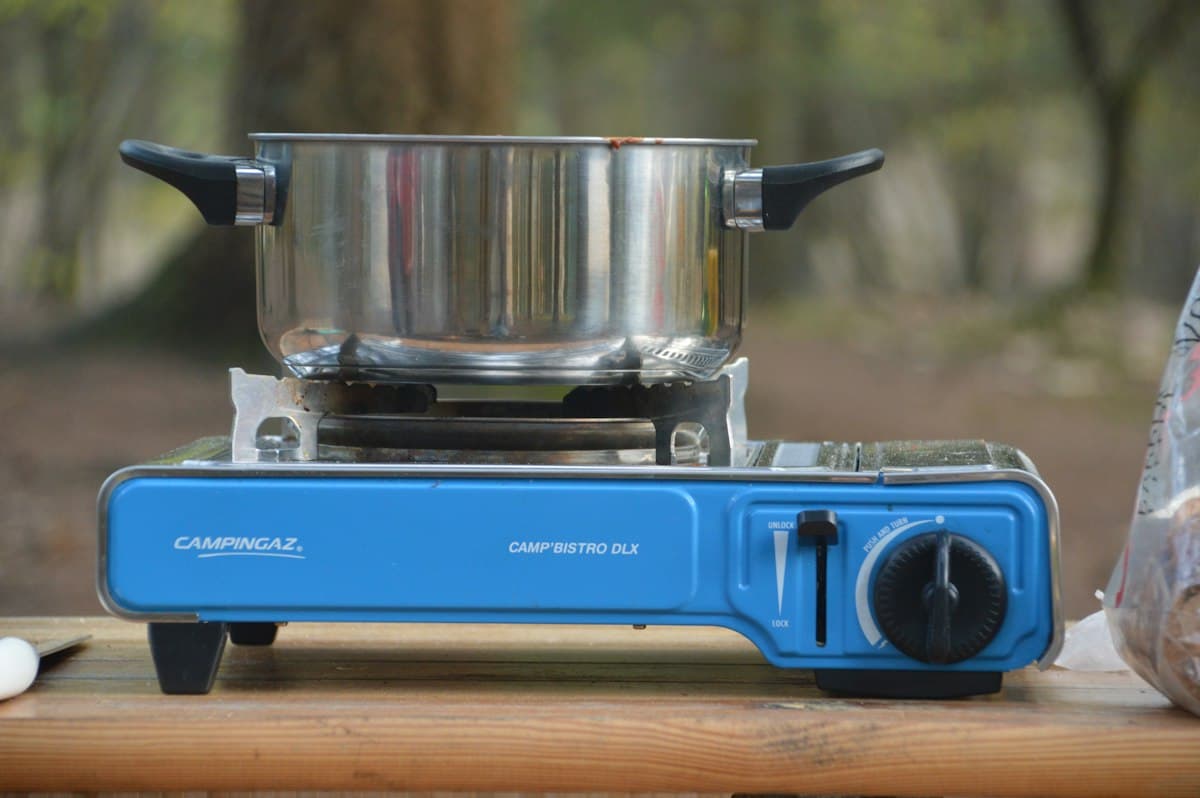
Hiking and Bikepacking Stove Comparison: Gas, Liquid Fuel, or Alcohol?
Choosing a stove for hiking or bikepacking seems simple enough — until you need to use it at 2,000 meters in -5°C conditions and the gas canister refuses to build pressure. Technical specs advertise boil times measured at 22°C in a lab. The mountains play by different rules.
This comparison covers three technologies — gas, liquid fuel, and alcohol — with particular attention to cold-weather performance, the decisive factor that product specs systematically leave out.
Gas, Liquid Fuel, Alcohol: Three Different Philosophies
The three fuel types work differently and serve different needs.
Gas: Maximum Simplicity, Temperature-Dependent
Gas stoves use butane/propane mix canisters (most often 70/30 or isobutane/propane). The flame lights instantly, output is precisely adjustable, there's no priming phase. It's the choice for hikers who want to light their stove, boil water, and pack up.
The limitation is well-known but rarely explained clearly: canister pressure depends directly on ambient temperature. Isobutane has a vapor pressure of about 3 bar at 20°C, but drops below 1 bar at 0°C and becomes nearly unusable at -10°C. In practice, on a November mountain or a winter bivouac, gas burns poorly, slowly, and sometimes not at all if the canister is cold.
The classic workaround: keep the canister in your sleeping bag overnight, warm it against your body before use, or flip it upside down if your stove supports liquid-feed mode. These techniques work, but they reveal a genuine technological limitation.
Liquid Fuel: Reliable in Cold, Complex to Use
Liquid fuel stoves (MSR WhisperLite, Primus OmniFuel type) run on unleaded petrol, kerosene, sometimes diesel or jet fuel. Since pressure is provided by a manual pump rather than being temperature-dependent, they start at -20°C without hesitation. It's the technology of high-altitude expeditions, Arctic crossings, and long-duration outings in extreme conditions.
The downsides are real. Startup requires a priming phase (about 30 seconds of burning to heat the jet before ignition). Fine flame adjustment is less precise than gas. The risk of liquid fuel leaks demands careful maintenance. And the fuel isn't always easy to find — a 500ml flask lasts several days, but you need to plan ahead.
For hikers who mostly bivouac in season (March to November) below 2,500 meters, the added complexity of liquid fuel isn't justified.
Alcohol: Minimalist and Unpredictable
Alcohol stoves (Trangia burners, DIY cat stoves) use denatured alcohol or 90% spirit. No moving parts, weight in the tens of grams, cost almost nothing.
The tradeoffs: no flame adjustment, boil times two to three times longer than gas, sensitivity to wind, fuel hard to find internationally. In strong wind, much of the heat goes into the air. In cold, alcohol evaporates more slowly and output drops significantly.
Alcohol suits ultralight solo outings where weight is an absolute obsession and weather conditions are favorable. For regular mountain bivouacking in France, it adds constraints that stack up.
Gas in Cold Weather: What Really Happens
This is the point almost no product spec mentions honestly, yet it defines the real-world usefulness of your stove.
Pure butane no longer works below 0°C (its evaporation temperature is -0.5°C). Isobutane, more capable, works down to about -12°C — but with greatly reduced pressure, meaning greatly reduced output.
In practice, at 0°C with an isobutane canister:
- The advertised boil time doubles or triples
- The canister cools during use (endothermic process), worsening the pressure drop
- A half-empty canister performs even worse than a full one
The most effective solution: keep the canister in your sleeping bag until the last moment, then cook quickly. Below -5°C, even this precaution becomes insufficient with standard gas. If your planned bivouacking spans September to May in the mountains, seriously consider either a high-performance isobutane/propane blend (Optimus, MSR IsoPro) or switching to liquid fuel.
Integrated System or Separate Burner
The gas stove market splits into two distinct use categories.
Integrated Systems (Jetboil-type)
The Jetboil Sumo is the canonical example. The burner, pot, and heat exchanger (aluminum fins) form a compact unit that stores inside the pot itself. The heat exchanger is key: it transfers up to 80% of flame heat to the liquid (versus 40-50% for a separate burner with a standard pot).
The result: 1 liter of water at boiling point in 3 to 4 minutes with 30-40% less gas consumption than an equivalent separate burner. For multi-day bivouacking, this efficiency translates directly to canisters lasting longer.
Limitations: you can't cook properly in the cylindrical pot (stirring is awkward), the system is heavier than a standalone burner, and the cost is higher (€150-200).
Standalone Burners
The Campingaz Bleuet 206 Plus represents the other extreme: a basic burner at €18-25, compatible with Campingaz 206 canisters (puncture-valve, non-detachable). Simple, available throughout France, perfect for the occasional hiker who bivouacs two or three times a year.
Between the two, burners like the MSR PocketRocket, Primus Express, or BRS-3000 offer a good middle ground: small, light, compatible with standard-valve canisters (EN417), precise flame control, usable with any pot. They cost €30-80 depending on build quality.
The choice depends on your use case:
- "Freeze-dried" bivouacking (boiling water only): integrated system for speed and fuel efficiency
- Real cooking with multiple dishes: separate burner with an appropriate pot, more versatile
- Lightweight bivouacking on a budget: compact burner around €30-40
Actual vs. Advertised Boil Times
The boil times printed on packaging are measured under standardized conditions (22°C, no wind, water at 15°C) that have nothing to do with real-world hiking conditions.
A more realistic order of magnitude:
| Condition | Advertised | Real-world estimate |
|---|---|---|
| 22°C, no wind | 3 min/liter | 3 min/liter |
| 10°C, light wind | 3 min/liter | 5-6 min/liter |
| 5°C, moderate wind | 3 min/liter | 8-10 min/liter |
| 0°C, wind, cold canister | 3 min/liter | 15-20 min/liter |
These estimates vary by model and windscreen quality. A good windscreen (aluminum, well-positioned) can cut these times by 30-40%.
The practical rule: always double the advertised time when planning fuel supply. If the manufacturer says "3 min/liter with a 100g canister," plan on 6 min/liter and adjust based on your field experience.
Total Weight: Stove Plus Fuel
The ultralight stove trap is reasoning only about stove weight, without factoring in the fuel.
For a 3-day bivouac (6 hot meals + 6 coffees):
- Alcohol: 30g burner + 120ml alcohol (~90g) = 120g
- Gas, standalone burner: 70g + 100g canister = 170g
- Jetboil-type: 185g + 100g canister = 285g, but 30% less consumption, so 73g canister = 258g
- MSR liquid fuel: 260g + 120ml fuel (~100g) = 360g
The alcohol system wins on raw weight for short trips. On a 10-day expedition, the Jetboil's efficiency compensates for its higher weight by reducing the fuel you carry.
The basic formula: for trips under 5 days, a good lightweight standalone burner (BRS or MSR PocketRocket type) offers the best weight-to-efficiency ratio. For trips of 7+ days, the integrated system becomes competitive on total weight.
Canisters: Sizes, Availability, End of Life
This practical point is often overlooked and can ruin an outing.
Canister Formats
In France (and most of Europe), there are two incompatible connection systems:
-
Standard EN417 valve (a.k.a. "Lindal valve"): used by MSR, Primus, Optimus, Snow Peak, Jetboil, BRS, etc. Screw-on, detachable, cross-brand compatible.
-
Campingaz system (puncture valve, non-detachable): 206, CV270, CP250 canisters. Once the stove is screwed on, the canister is punctured and cannot be removed without emptying it. Advantage: available in almost every supermarket and campsite in France.
If you travel internationally: the EN417 valve is the international standard. Campingaz canisters are essentially unavailable outside Western Europe.
Canister End of Life
Partially used gas canisters cannot be recycled as ordinary scrap metal — they still contain residual pressurized gas. The legal channel: recycling centers accept punctured or depressurized canisters (depressurization tools are sold separately).
Field practice: use canisters completely before recycling. A half-empty small canister is worthless to carry back.
Choosing the Right Size
| Size | Weight | Estimated duration | Use case |
|---|---|---|---|
| 100g | 160g | 1-2 nights | Weekend |
| 230g | 280g | 3-4 nights | Long weekend |
| 450g | 500g | 7-8 nights | Week-long trip |
For regular outings, 230g canisters offer the best balance between unit weight and carrying fewer of them.
Our Recommendation
No universal answer, but clear rules by use case:
- Day hikes or occasional bivouacking: a basic gas burner is enough. Minimal investment, maximum simplicity.
- Regular spring-to-fall bivouacking: a compact burner (MSR PocketRocket, BRS-3000, Primus Express) with EN417 canisters offers versatility and widespread canister availability.
- Winter bivouacking or high mountain: either an integrated system with high-performance isobutane/propane canisters, or switch to liquid fuel.
- Long-duration autonomy (7+ days): the Jetboil Sumo or equivalent to minimize fuel weight, or liquid fuel for extreme conditions.
On bivouac trips, the stove doesn't work in isolation. Check our selection of the best sleeping bags for bivouacking and our ground mat comparison to complete your kit. And if you're new to bivouacking, our guide on regulations and best practices will help you avoid unpleasant surprises.
One final point: stoves need maintenance. Canister O-rings, jets, piezo ignitors — these are parts that age. An annual inspection and jet cleaning before the season prevents 80% of field failures.
As an Amazon Associate, we earn from qualifying purchases. Links marked with an external icon are affiliate links.
Related reading
Sleeping Pad Comparison 2026: How to Choose for Backpacking and Bivouacking
Choosing a sleeping pad for backpacking: R-value explained, inflatable vs foam vs self-inflating, weight and real comfort. Six pads compared by season.
The Best Sleeping Bags for Bivouacking: Complete 2026 Guide
How to choose the best sleeping bag for bivouac hiking? Down vs synthetic, comfort temperature, weight — our complete selection for sleeping under the stars.
How to Choose a Hiking Tent: The Complete Guide
Weight, waterproofing, capacity, 3-season or 4-season… Everything you need to know to choose the right hiking tent for your profile and your adventures.