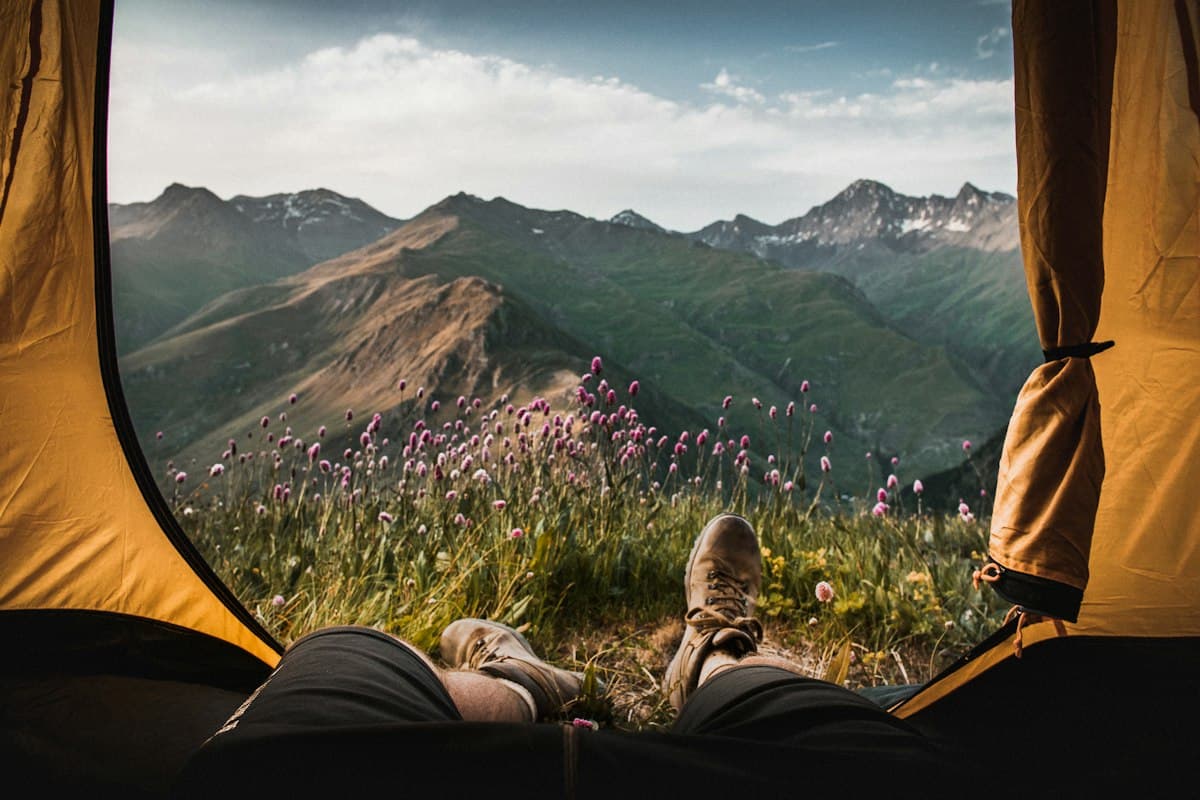
Sleeping Pad Comparison 2026: How to Choose for Backpacking and Bivouacking
Most gear guides will tell you that a sleeping pad is primarily a matter of comfort. That's true — but what they fail to explain is why you woke up freezing in your sleeping bag even though the label said it was rated to −5 °C. The answer comes down to two letters: R-value.
A sleeping pad has two jobs. The first is comfort — cushioning you from rocks, roots, and hard ground. The second is thermal insulation — interrupting the heat transfer between your body and the ground, which can absorb up to 25 times more heat than the surrounding air.
That second job is consistently underestimated. On a cold bivouac night, you can lose as much heat downward — through conduction — as you lose to the air in every other direction combined. The warmest sleeping bag in the world cannot protect you if your pad isn't up to the job.
The R-Value: The Only Number That Matters
The R-value measures a material's thermal resistance: the higher the number, the better the insulation. Since 2020, the ASTM F3340 standard has required all manufacturers to use the same testing procedure, which finally makes R-values comparable across brands.
Here's how to interpret those numbers by season:
- R below 2: summer only, mild nights (above 15 °C)
- R 2 to 3.9: spring and summer, down to around 5 °C
- R 4 to 5.9: 3-season, down to −10 °C with a matched sleeping bag
- R 6 and above: 4-season, snow and high-altitude conditions
The mistake everyone makes
The temperature rating printed on your sleeping bag assumes you're using a standard insulating pad underneath. Without a pad — or with an under-rated one — the numbers become meaningless. The felt temperature difference between an R2 pad and an R5 pad can be as large as 8 to 10 °C.
In practice: if you're sleeping in a −5 °C bag on an R1.5 pad, you're technically sleeping on a summer mat. Your night turns miserable the moment temperatures drop below 10 °C, even if your bag is perfectly matched to conditions.
For autumn bivouacs in southern France — the Alps, Verdon, Luberon, Cévennes — where nights drop below 5 °C by September, aim for at least R 3.5. For high-altitude summer bivouacs (above 2,500 m), target R 4 or higher.
Inflatable, Self-Inflating or Foam: The Three Technologies
There are three main families of sleeping pads, each with its own trade-offs.
Inflatable pads
Light and packable, they offer the best weight-to-R-value ratio on the market. High-end models incorporate insulation between the air chambers — synthetic fill or down — achieving R-values of 4 to 6 at under 500 grams.
The downside: you need to inflate them, either by mouth or with a pump sack, taking two to five minutes. Puncture risk is real, even with today's improved materials. Always carry a repair kit.
Self-inflating pads
These combine open-cell foam — which expands naturally when the valve opens — with a waterproof shell. Comfort tends to be better than an equivalent-thickness inflatable, and durability is significantly higher.
The trade-off: heavier and bulkier. Hard to get below 600 g for a 3-season model. Their strength is resilience — no punctures possible, and they keep working even if lightly damaged.
Foam pads
Indestructible, cold-proof, unpuncturable. Unroll, lay down, sleep. Closed-cell foam pads are ideal for frequent bivouacking or extreme conditions. The obvious downside: bulky. They ride strapped to the outside of your pack and can be awkward on technical terrain.
The advanced combo: some alpine hikers layer a foam pad (R2) under a light inflatable (R4) for a combined R-value of 6 at a total weight under 800 g — a strong 4-season system.
Weight and Packed Volume
On a multi-day backpacking trip, every gram counts. Here are the reference ranges:
| Type | Average weight | Packed volume |
|---|---|---|
| Foam pad (75 × 120 cm) | 300–400 g | Rolls outside the pack |
| Self-inflating 3-season | 600–800 g | 3–4 litres |
| Inflatable 3-season | 350–500 g | 1.5–2.5 litres |
| Inflatable 4-season | 500–700 g | 2–3 litres |
For multi-day backpacking with a 50-litre pack, an inflatable is the logical choice. For occasional bivouacking in a lightweight setup (25–30 litre pack), a foam pad strapped to the outside remains hard to beat on the simplicity-to-bulk trade-off.
Comfort by Sleeping Position
Your preferred sleeping position directly affects which pad is right for you — a factor most gear guides skip entirely.
Back sleepers: 5 to 7 cm thickness is generally enough. Contact with the ground is spread across the whole back surface, distributing pressure well. Self-inflating and thinner inflatable pads (5–7 cm) work perfectly.
Side sleepers: pressure concentrates on hips and shoulders. You need at least 8 cm of thickness, ideally a profile that's wider at the shoulders to prevent your arm from sliding under the pad during the night. Inflatables in the 9–10 cm range are much better suited.
Stomach sleepers: thick or thin, the difference is minimal. Discomfort comes from the neck, not the pad. A foam mat is perfectly adequate.
Width: standard pads measure 50–51 cm. "Wide" models (65 cm) solve the problem of restless sleepers who slide off the pad at night, but at the cost of extra weight and bulk.
Noise: The Overlooked Criterion
If you bivouac in a shared tent or a mountain hut, your pad's noise level can disturb everyone around you — and wake you up too if you're a light sleeper.
Standard baffled inflatable pads produce an audible rustling sound with every position change. Some models were designed specifically to address this: their structure reduces friction noise between air chambers.
Self-inflating pads and foam mats are silent by nature. If you regularly bivouac in company or in shared shelters, noise deserves a prominent place in your decision.
Six Pads by Season
For ultralight summer bivouacs
The Therm-a-Rest Z Lite Sol (closed-cell foam, R-value 2, ~410 g) remains the go-to for technical summer routes where carrying an inflatable would be a liability. Indestructible, maintenance-free, nothing to puncture. Its accordion fold straps easily to pack side straps.
For 3-season spring and autumn: Sea to Summit Ether Light XT Insulated — from €149.95
R-value 3.2, 435 g (Regular), 10 cm thick. The standout feature is its comfort profile: transverse air cells create genuine support for side sleepers. Synthetic insulation keeps you warm down to 0 °C with a matched sleeping bag. The integrated pump sack makes inflation easy in any conditions. Hard to beat on weight/comfort/insulation for bivouacs from March to November in southern mountain ranges.
The benchmark self-inflating pad: Therm-a-Rest ProLite Plus — from €129.00
R-value 3.7, 680 g. It inflates almost entirely on its own in 10–15 minutes; two breaths at the valve finish the job. The open-cell foam delivers immediate comfort even on uneven ground. Durability is exceptional — Therm-a-Rest pads from the 1990s are still in use. For hikers who bivouac one or two nights per month through autumn, it's the economical long-term choice.
For cold 4-season nights: Nemo Tensor All Season Insulated — from €219.99
R-value 5.4, 584 g. The highest R-value in this comparison, with remarkable attention to noise: the Spaceframe structure dampens the rustling typically associated with inflatable pads. This is the pad of choice for high-mountain bivouacs in autumn and spring, and for winter traverses below 1,500 m. The price is steep, but it replaces both a 3-season and a 4-season pad if your hiking calendar runs year-round.
For budget-conscious hikers
The Forclaz MT500 Airbed (approximate R-value 3.5, under €60, Decathlon exclusive) is a serious entry-level option for occasional bivouackers without a large gear budget. Comfort and dimensions are adequate for spring and summer outings. Not available through our affiliate partners, but readily found in stores.
For bikepacking and ultralight summer use
The Sea to Summit Ultralight Insulated (R-value 2.3, 290 g Regular) is built for outings where weight is paramount. It trades some insulation for an impressive weight reduction, and works best in summer or paired with a foam mat for cooler nights.
Final Takeaways
Start with the R-value. Not the brand, not the design — the R-value matched to your actual bivouac conditions. Then choose the technology that suits your practice: inflatable for ultralight multi-day trips, self-inflating for durability and comfort on regular use, foam for simplicity and bulletproof reliability.
To build a complete sleep system, pair your pad with a well-chosen sleeping bag and check the bivouac regulations in France before choosing your spot.
Sleep well under the stars.
As an Amazon Associate, we earn from qualifying purchases. Links marked with an external icon are affiliate links.
Related reading
The Best Sleeping Bags for Bivouacking: Complete 2026 Guide
How to choose the best sleeping bag for bivouac hiking? Down vs synthetic, comfort temperature, weight — our complete selection for sleeping under the stars.
How to Choose a Hiking Tent: The Complete Guide
Weight, waterproofing, capacity, 3-season or 4-season… Everything you need to know to choose the right hiking tent for your profile and your adventures.
Best Hiking and Bivouac Headlamps: a Complete Buying Guide
Which headlamp should you choose for hiking and bivouacking? Real lumens, battery life, waterproofing and red mode: five models compared.