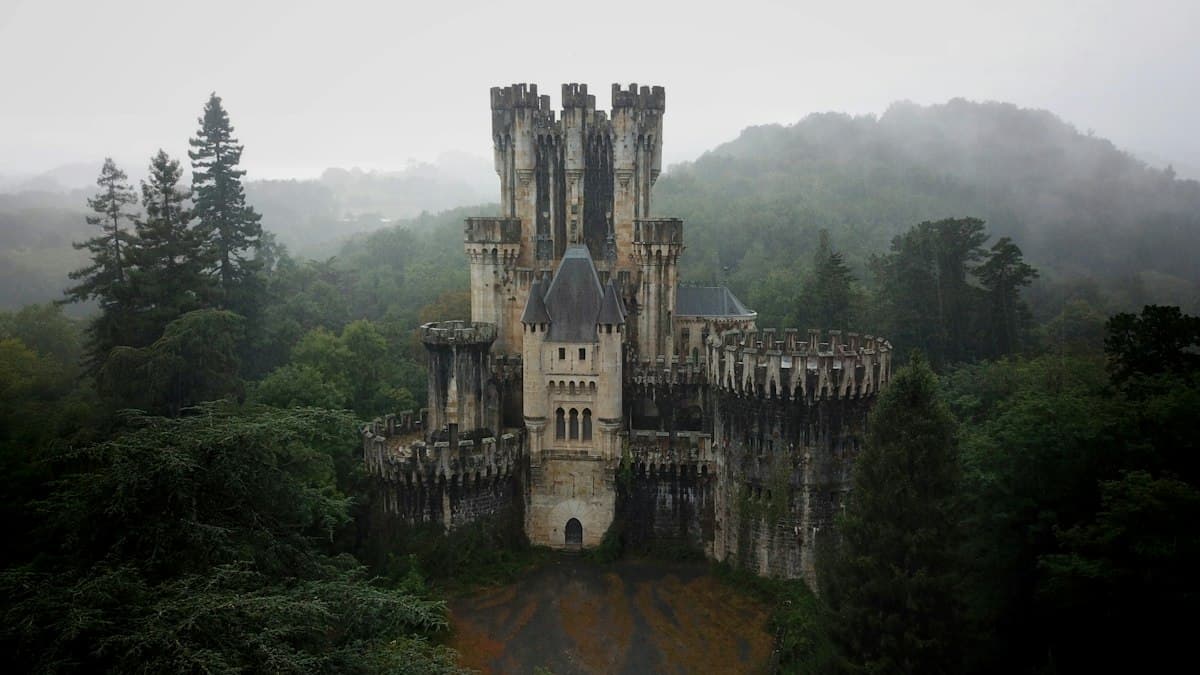
Halloween: 6 Mysterious Hikes and Their Legends
October 31st is just around the corner. What better time to explore mysterious France — the France of enchanted forests, crumbling castles, and unfathomable chasms? These six hikes aren't just beautiful: they take you to places where history and folklore merge at every bend in the trail.
1. The Forest of Brocéliande — In the Footsteps of Arthur and Merlin
Brittany | Ille-et-Vilaine
The forest of Paimpont, commonly known as Brocéliande, is France's most famous enchanted wood. According to medieval texts, it was here that Merlin the Wizard was imprisoned by the fairy Viviane, that Lancelot du Lac was raised at the bottom of a lake, and that King Arthur found the sword Excalibur.
The reality is no less haunting: black ponds fringed by ancient oaks, a Valley of No Return where mist seems to float between the trees, and a granite tomb known as the "Tomb of Merlin" where visitors still leave offerings.
Recommended hike: The Val sans Retour loop from Tréhorenteuc (about 10 km, easy to moderate). It follows the Falaise des Faux Amants (Cliff of False Lovers) and the Miroir aux Fées (Fairy Mirror), a pond with an otherworldly atmosphere in the morning mist.
Local lore: According to Celtic tradition, the forest jealously guards its secrets. Locals in the village of Tréhorenteuc still tell stories of hikers who got lost trying to cut through the woods — even with GPS.
2. The Padirac Chasm — Descending to the Underworld
Lot | Occitanie
The Padirac chasm opens in the limestone causse like a wound in the earth: a vertical pit 35 metres in diameter, plunging 75 metres deep. Inside, an underground river has carved its way through a 2-kilometre gallery for millennia.
Local legend holds that the devil himself stamped his foot to create the chasm, trying to force Saint Martin to surrender — the saint supposedly chose to leap over with his donkey rather than sell his soul. That's the story told in the local Quercy tradition, at least.
Recommended hike: The Lac des Gours loop from Padirac (4.2 km, easy, 56 m elevation gain) circles the edges of the chasm and follows the surrounding causse. You'll discover the characteristic calcaire limestone vegetation — twisted junipers and downy oaks.
For those wanting to go further, the view over Rocamadour from Padirac (7 km, moderate) offers a stunning panorama of the cliff-perched castle-sanctuary.
Gear tip: In autumn, the causses can be windy. Pack a lightweight windproof jacket for descents into the enclosed valleys.
3. The Abandoned Villages of the Cévennes — Stone Ghosts
Gard | Occitanie
The Cévennes bear the scars of a massive rural exodus. Between the 19th century and the 1960s, hundreds of hamlets were abandoned. What remains are black granite walls, terraces reclaimed by chestnut trees, and sometimes a fountain still flowing — as if the inhabitants had just left.
These "abandonnades" (as locals call them) have their own atmosphere: wind through the oaks, the sound of water, and that particular silence of places people have left behind.
Recommended hike: The loop at the Gates of the Cévennes (15.6 km, difficult, 437 m D+) passes through several of these ghost hamlets. Pack good waterproof boots — chestnut woodland paths can be slippery in autumn.
For a less demanding option, the Cévennes loop from Ganges (13.3 km, difficult) offers impressive views over gorges and hilltop villages.
Tip: Start early. In late afternoon, raking light picks out the stonework of old walls like no other time of day. And if you carry a headtorch, the final kilometres in the gathering dusk are hauntingly beautiful — see our article on hiking with less daylight after the clocks change.
4. Château de Montaigu — Ruins in the Heart of the Vendée
Vendée | Pays de la Loire
Built in the 10th century, Château de Montaigu witnessed both the Wars of Religion and the Vendée Wars. Only collapsed towers and dried moats remain today — but the site has a rare presence, especially at dusk when rooks wheel above the broken battlements.
The legend attached to the castle tells of a "White Lady" who appears in the ruins on full-moon nights — a classic of Poitevin-Vendéen folklore, but hard not to think about while walking along the empty moats.
Recommended hike: The Maison de la Rivière loop from Boufféré (19.5 km, expert, 97 m D+) is long but provides a full tour of the Montaigu area. For a more accessible version, the loop from Montaigu (5.8 km, moderate, 104 m D+) passes below the ramparts.
5. Les Demoiselles Coiffées — The Witch's Columns
Hautes-Alpes | Provence-Alpes-Côte d'Azur
These fairy chimneys — earth pillars topped with a cap of hard rock — populate the gullies of the Southern Alps like a petrified army. Science explains them through differential erosion: a hard stone protects the softer earth column beneath. But their popular name, "coiffed maidens", reveals another explanation: they are said to be young women turned to stone for dancing on a Sunday.
The most spectacular examples are at Théus (Hautes-Alpes), though you'll also find them in the Var gorges and around Digne-les-Bains.
Recommended hike: The Grotte des Demoiselles loop from Agonès (13 km, difficult, 442 m D+) combines these strange geological formations with views over the southern Cévennes.
For families: The demoiselles coiffées at Théus can be visited via a short path accessible from the village car park (under 2 km). A junior daypack is all you need for this short walk, ideal with curious children.
6. Hiking at Dusk Safely
The Halloween atmosphere is great. Coming back at night without a headtorch is not. Here are some basic rules for enjoying these sites safely.
Pack your night kit
- Headtorch with fresh or fully charged batteries: essential even if you think you'll be back before dark. In autumn, light disappears fast. A rechargeable headtorch with at least 200 lumens is a sound investment.
- Insulating layer: temperatures drop as soon as the sun sets. A lightweight packable down jacket in your pack takes up little space and can make all the difference.
- Whistle: simple and effective if you need to signal your position.
Stay on marked paths
All the sites presented in this article have waymarked paths. Off-piste in forest or on causse, even experienced hikers can become disoriented. Our article on night trails in Provence covers best practices for hiking in the dark.
Tell someone your plan
Before setting off, let a contact know your route, your expected return time, and the car park you're starting from. In an emergency, this information is invaluable for rescue services.
Check the weather
In autumn, fog can fill valleys in under an hour, making familiar paths unrecognisable. A GPS altimeter watch can help you keep your bearings even in poor visibility.
In Summary
These six destinations prove that France is a land of living mysteries and legends. From the Arthurian magic of Brocéliande to the petrified maidens of the Alps, every trail tells a story that the landscape itself seems to confirm.
Want to explore more hikes in France? Visit our Explore page to discover the best tracks from every region, filtered by difficulty and distance.
As an Amazon Associate, we earn from qualifying purchases. Links marked with an external icon are affiliate links.
Related reading
Hiking at Night in Winter: Headlamps and Safety
Night hiking in winter: headlamp battery life in the cold, snow reflection, orientation cues, and group safety management.
Dedicated GPS vs Smartphone for Hiking: The Definitive Comparison
Do you really need a dedicated GPS when you have a smartphone? Battery life, accuracy, cold resistance, and real costs: a clear verdict.
Hiking in the Verdon Gorge in Winter: 7 Routes to Discover the Canyon Off Season
Seven hikes in the Verdon Gorge in winter: deserted trails, turquoise water, and raking light far from the summer crowds.