Winter Hiking Nutrition: Eating Smart in the Cold
Winter fundamentally changes how your body burns energy and water. Yet most hikers head out for a cold-weather outing with the exact same kit as in summer — and return exhausted, sometimes dangerously so. Two traps repeat themselves every season: underestimating how many calories the cold demands, and mistaking the absence of thirst for proper hydration. This guide gives you the tools to eat and drink intelligently whenever temperatures drop below 5 °C.
Why Cold Weather Increases Your Calorie Needs
Your body is a heat engine. In cold weather, it runs at full capacity not only to move your legs forward, but also to maintain your core temperature at 37 °C. This thermoregulation burns extra calories — on top of physical exertion.
Research on soldiers and alpinists in cold environments estimates that energy requirements increase by 15 to 30 % compared to an equivalent effort in mild conditions. On a 5-hour hike with significant elevation gain, that difference can represent an additional 300 to 600 kcal.
Concretely: if you usually pack 400 kcal of snacks for a 4-hour outing, plan for 500 to 600 kcal in winter. Don't cut corners here — hypothermia develops first when energy reserves are depleted. A well-fuelled body resists cold infinitely better than one running on empty.
Winter Dehydration: Invisible but Real
This is winter's most dangerous trap: you barely feel thirsty. Cold air is dry, you breathe rapidly, and each exhale carries water vapour away. The result: you can lose 1 to 1.5 litres of water per hour without breaking a sweat, with no warning signal whatsoever.
Winter dehydration shows up as:
- Unexpected early fatigue
- Muscle cramps
- Impaired decision-making (a serious warning sign in the mountains)
- Headaches at the end of a hike
The basic rule: drink 400 to 600 ml per hour of effort, whether you feel thirsty or not. Set an alarm on your GPS watch every 30 minutes if needed.
An insulated water bottle of at least 1 L is essential in winter. It keeps your drink liquid and retains heat if you opt for a hot drink — more on that below. Avoid hydration bladder hoses (such as CamelBak) below 0 °C: the tube freezes within minutes.
Foods That Freeze and Become Useless
This is the classic mistake: packing your snack bag exactly as you would in summer, only to discover mid-trail that everything has turned rock-hard. Some foods are particularly vulnerable:
Avoid below 0 °C:
- Bananas and fresh fruit (freeze quickly, rubbery texture)
- Chocolate bars (rock-hard, impossible to chew)
- Energy gels (unless kept warm against your body, they become thick and hard to swallow)
- Sandwiches with moist fillings (bread freezes, fillings crystallise)
- Thin uninsulated water bottles (freeze inside the pack)
What holds up well:
- Dried fruits (raisins, apricots, dates) — stay pliable down to −10 °C
- Nuts and seeds — high in fat, largely frost-resistant
- Cereal and fruit bars (without chocolate coating)
- Hard cheese (comté, gruyère) — holds down to −5 °C
- Dry-cured meats (salami, chorizo)
- Fruit paste confections — soft even in deep cold
One simple trick: keep your food close to your body, in a jacket or trouser pocket. Body heat is enough to keep snacks at a workable temperature. Avoid outer pack pockets exposed to the wind.
Hot Drinks: More Than Comfort
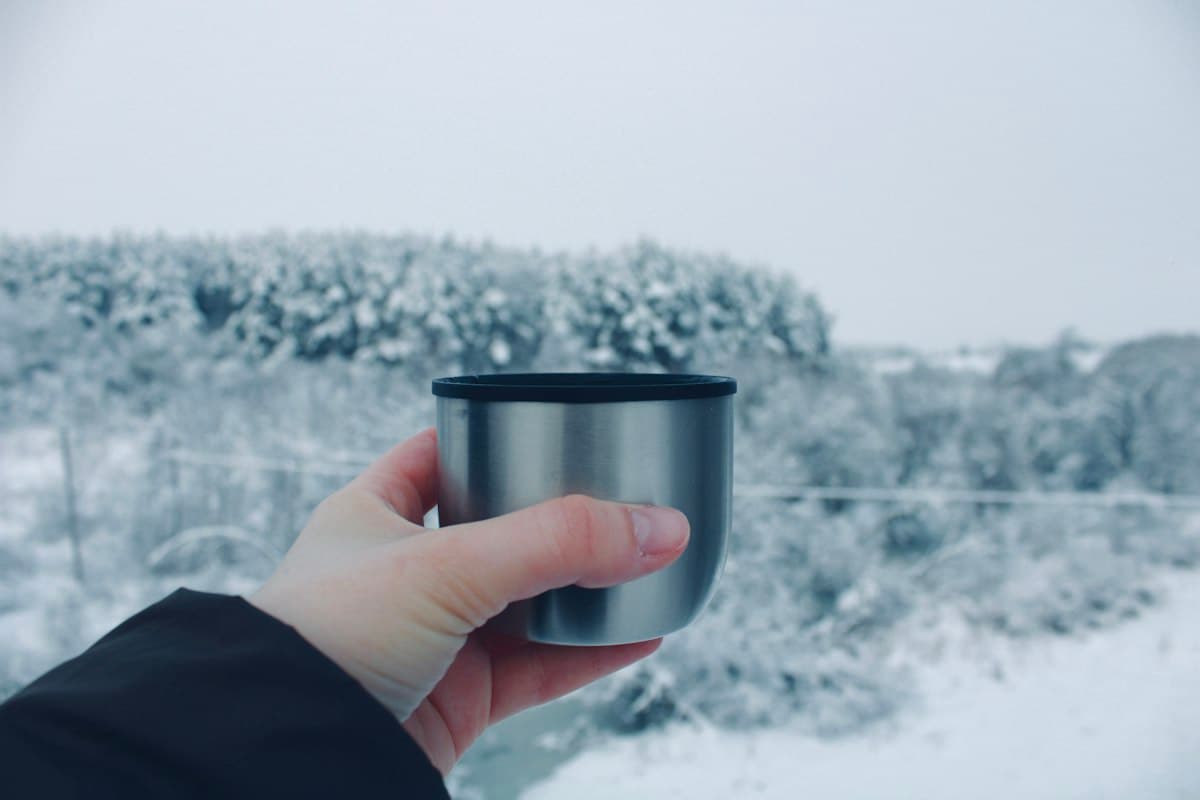
A hot drink on a winter hike is not a luxury — it is a thermoregulation tool. A cup of tea or broth can raise core temperature by 0.5 to 1 °C in 15 minutes, a meaningful difference for a body that is starting to tire.
Always bring a 1 to 1.5-litre thermos of hot drink:
- Tea or herbal infusion, lightly sweetened (bonus carbohydrate input)
- Vegetable or chicken broth (sodium to compensate for perspiration)
- Hot chocolate (energy and morale)
The Qwetch 1.5 L insulated bottle is a solid option: its double-wall insulation keeps liquids hot for over 12 hours, and the 1.5 L format covers several hours of hiking without refilling.
For longer outings or multi-day trips, a compact stove like the Campingaz Bleuet lets you boil water in minutes on the spot. A freeze-dried broth cube weighs nothing, fits in any pocket, and becomes a reviving hot drink in ten seconds. In deep cold, gas cartridges perform less efficiently (increased viscosity): pull the cartridge from your jacket pocket just before lighting to keep it warm.
Regular Snacking Over the Big Lunch Break
Winter hiking logic is different from summer logic. Taking a long one-hour lunch break means sitting still in the cold, which cools the body down rapidly. The body also diverts significant energy to digestion, at the expense of thermoregulation.
The best winter strategy: snack every 45 to 60 minutes, without sitting down for a real break.
Organise your food into small individual packs that are easy to reach:
- A small handful of nuts and raisins
- A fruit paste or cereal bar
- A few slices of salami or cheese
- A square of dark chocolate (if temperatures stay above −2 °C)
If you want a proper meal break, warm yourself up first: pick up the pace for 10 minutes before stopping, eat quickly, then move again before the body cools down.
For calories: aim for 200 to 300 kcal per hour of winter hiking. Over a 5-hour outing, that amounts to roughly one kilogram of dense food — more than most people expect.
What Stays Edible at −5 °C
Here is a practical selection of foods that hold up well at the sub-zero temperatures commonly encountered on winter hikes in France (Provence, Vosges, Massif Central):
| Food | Frost resistance | Caloric density |
|---|---|---|
| Medjool dates | Very good | ★★★★☆ |
| Cashews and walnuts | Excellent | ★★★★★ |
| Fruit paste confections | Very good | ★★★☆☆ |
| Dry salami | Good (to −5 °C) | ★★★★☆ |
| Hard cheese | Good (to −5 °C) | ★★★★☆ |
| Wrapped gingerbread | Good (compact) | ★★★☆☆ |
| Cereal bars (no chocolate) | Very good | ★★★☆☆ |
| Peanut butter sachets | Excellent | ★★★★★ |
Individual peanut butter sachets are particularly practical: ultra-caloric (~180 kcal per 32 g), pliable at −15 °C, easy to squeeze out even with gloves on.
For hikers planning regular outings in winter conditions, freeze-dried meals are an ideal backup: lightweight, ready in 5 minutes with boiling water, and available in sufficiently caloric versions (600 to 900 kcal per pouch).
Preparing Your Supplies the Night Before
A few simple habits to optimise your winter food kit before departure:
- Pre-portion everything the evening before in zip-lock bags. You won't have to rummage through your pack with gloves on.
- Fill the thermos at the last moment, just before leaving, to maximise heat retention.
- Keep a 20 % reserve: cold and deteriorating conditions can extend outings unexpectedly. Always carry enough for one extra hour.
- Set reminders: on a sticky note or your phone, write down when to snack and when to drink next. In winter, it is easy to forget to eat and drink when you are focused on the terrain.
For a comprehensive look at hiking nutrition, check out our complete nutrition and hydration guide. For meal prep ideas and snack recipes, see our hiking picnic article.
Looking for winter routes suited to these conditions? Browse our collection of winter hikes in Provence on OpenRando.
As an Amazon Associate, we earn from qualifying purchases. Links marked with an external icon are affiliate links.
Related reading
Eating and Drinking on the Trail: The Complete Hiking Nutrition Guide
How much to drink, what to eat, and how to plan your meals on the trail? The complete guide to nutrition and hydration for hiking without bonking or heat exhaustion.
How to Prepare a Winter Hike
Preparing a winter outing: how to read an avalanche risk bulletin, calculate your time buffer, essential gear, and your fallback plan.
How to Purify Water While Hiking: The 4 Methods Compared
Filter, tablets, UV or boiling: the four methods for purifying water while hiking, what they actually eliminate, and which one to choose.