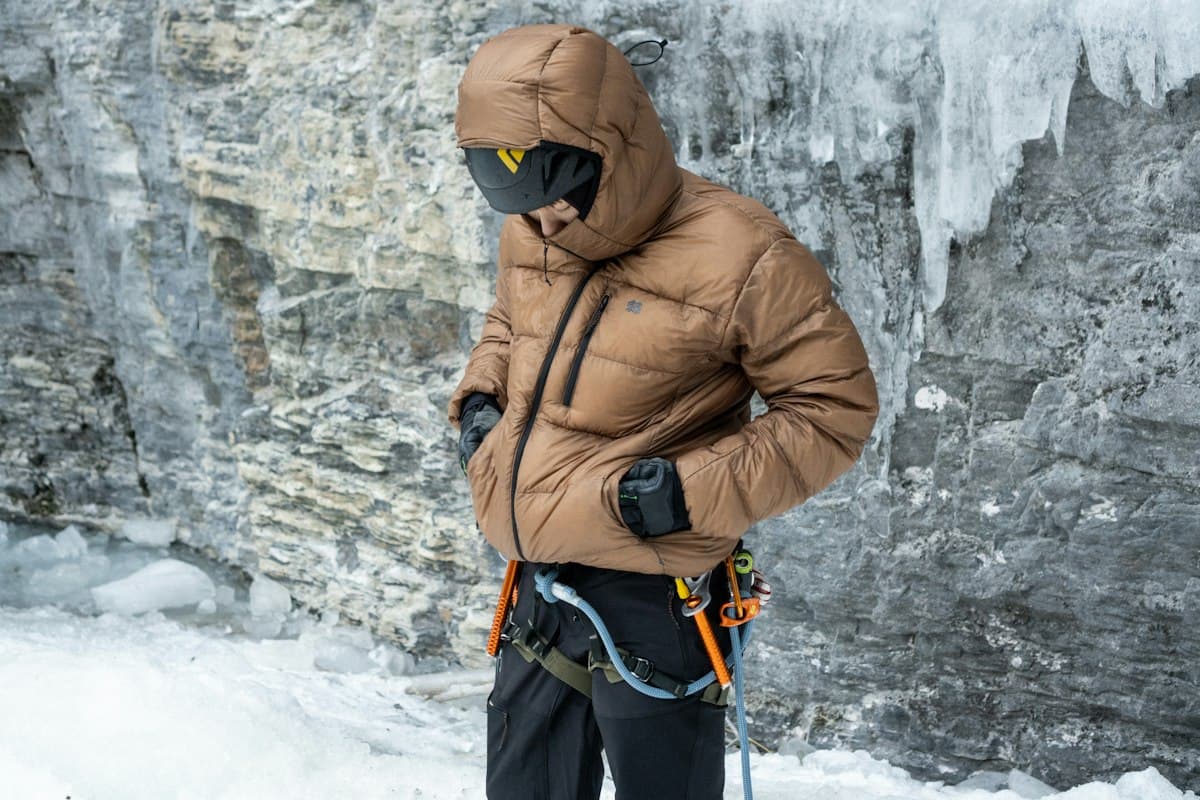
Lightweight Hiking Down Jackets Compared: Down vs Synthetic Insulation
The lightweight hiking insulation layer is one of the most misunderstood pieces of gear on the market. Product specs are loaded with technical figures — 600 fill, 90/10, 80 grams — without ever explaining what they mean in practice on the trail. The result: disappointing purchases, unused jackets buried at the bottom of your pack and, sometimes, colder bivouacs than expected.
This comparison cuts through the noise: what is fill power, and why is it the only number that truly matters? Natural down or synthetic insulation — which should you choose based on your terrain? And when does a down jacket become useless, or even counterproductive?
1. Fill Power: What 600 or 800 Cuin Actually Means
Fill power (measured in cubic inches, or "cuin") describes the volume that one ounce (28 g) of down occupies after being compressed and released. The higher the number, the better the down's ability to trap warm air around your body — meaning better insulation for less weight.
Practical reference points
| Fill power | Typical profile | Best use |
|---|---|---|
| 500–600 fill | Entry level / synthetic | 3-season hiking, tight budget |
| 650–700 fill | Mid-range natural down | Alps in summer, autumn camping |
| 750–800 fill | High-end lightweight | Multi-day, cold bivouac |
| 850–900 fill | Ultra-lightweight, premium | Alpine climbing, ultratrail |
Why fill power trumps everything else: 800-fill down can deliver the same warmth as 600-fill using 30–40% less material. That weight saving goes directly into your pack weight. For equal thermal performance, always choose the highest fill power your budget allows.
What fill power doesn't tell you
Fill power measures insulation quality, not the final warmth of the garment. That also depends on fill weight (grams per m²), cut, and the number of baffles (internal sewn walls that prevent cold spots). An 800-fill jacket with minimal down fill will be less warm than a well-filled 650-fill one.
2. Down vs Synthetic: Moisture Makes the Decision
This is where most buyers go wrong. The real question isn't "which is better?" but "what conditions will you face?"
Natural down: the champion in dry conditions
Goose or duck down is unmatched in two key areas:
- Warmth-to-weight ratio: at equal quality, it insulates better for fewer grams.
- Compressibility: it crushes down to a minimal volume (fist-sized for the best pieces) and instantly lofts back up.
Its Achilles heel: it collapses when wet. Wet down loses 80–90% of its insulating capacity. If you sweat heavily, hike in consistently rainy or misty conditions, or bivouac without a waterproof stuff sack, down will fail you precisely when you need it most.
DWR-treated down (Down Water Resistant) resists light drizzle and brief humidity, but won't hold up against heavy rain or sustained condensation.
Synthetic insulation: the reliable all-weather choice
Synthetic fibres (PrimaLoft, Thermoball, Coreloft…) retain 60–70% of their insulating power even when wet. They dry three to four times faster than down.
Drawbacks:
- Heavier: for equivalent thermal performance, expect 20–30% more weight.
- Less compressible: pack volume increases noticeably.
- Shorter lifespan: fibres break down after 50–80 wash cycles, versus 200+ for quality down.
The practical rule
- Dry climate, high altitude, bivouac in a waterproof stuff sack → natural down, 750 fill minimum.
- Wet mountain ranges (Northern Alps, Pyrenees, Brittany), hiking in rain, multi-day without shelter → synthetic or DWR-treated down with a mandatory waterproof stuff sack.
- All-conditions versatility → DWR-treated 750-fill down in a waterproof stuff sack. This is the favourite compromise among long-distance hikers.
3. Real-World Weight-to-Warmth Performance
The weight printed on the label is measured on the jacket alone, without packaging, in a medium size. Here are realistic benchmarks for a mid-season trail or hiking jacket:
| Category | Typical weight | Use temperature |
|---|---|---|
| Ultra-light (jacket) | 80–150 g | +5°C / light activity |
| Light (jacket) | 150–250 g | 0°C / rest stop |
| Intermediate (jacket) | 250–400 g | −5°C / bivouac |
| Warm (full down coat) | 400–700 g | −10°C and below |
For multi-day hiking, the 150–250 g range covers 90% of 3-season situations. Below 150 g, warmth becomes insufficient for a cold bivouac. Above 400 g, the weight starts to accumulate on longer treks.
Watch out for marketed comfort temperatures: they're tested on a male mannequin, without wind, standing still. Add 5–8°C of margin if you tend to run cold, or if you're hiking at altitude in wind.
4. Down Traceability and Certification Labels
The ethical dimension of down sourcing is real. Live plucking and force-feeding are documented practices in some supply chains. Several certifications guarantee traceable and humane sourcing:
- RDS (Responsible Down Standard): certifies full farm-to-jacket traceability, bans live plucking and force-feeding. The reference standard used by Patagonia, The North Face, and Fjällräven.
- Global Traceable Down Standard (TDS): even more granular traceability.
- bluesign®: primarily covers chemical treatment of fabrics, not down origin.
For synthetic insulation, leading brands now use recycled fibres (PrimaLoft® Gold Eco, Responsible REPREVE). A meaningful factor if sustainability matters in your decision.
5. Compressibility and Pack Volume
On a multi-day trip, volume matters as much as weight. A poorly compressible jacket can occupy a third of your pack. How to assess this:
- Integrated stuff pocket: the jacket packs into one of its own pockets. This signals compressibility, but doesn't guarantee it.
- Compressed volume: the best models achieve 1.5–2 litres (800-fill down, 150 g jacket). Equivalent synthetics occupy 3–4 litres.
- The fist test: quality down fits in your closed fist. If it's a struggle, the jacket lacks fill or the outer fabric is too stiff.
For hikers carrying more than 10 days of kit, the volume difference between down and synthetic can represent the equivalent of a full day's food supply.
6. When a Down Jacket Becomes Useless
Knowing what to choose is only half the battle — understanding when not to wear a down jacket is equally important:
- During sustained effort: a down jacket is not an active layer. It's designed for rest stops. Worn while climbing, it saturates with sweat vapour almost immediately and loses its thermal efficiency.
- Without a windshell in strong wind: compressed down doesn't block air. Without a wind-resistant outer layer, a down jacket in strong wind simply doesn't warm you.
- As a single layer in heavy rain: even DWR-treated, a non-waterproofed down jacket should be reserved for sheltered rest stops.
The optimal use is clear: the rest-stop layer. Stop, put it on in 10 seconds, move on. For that role, an ultra-lightweight packable jacket between 80 and 150 g is more than sufficient and won't weigh down a long trip.
Summary: How to Choose
You hike in the Northern Alps or Pyrenees with rainy days: synthetic or DWR-treated 700+ fill down, stored in a waterproof stuff sack.
You hike in Provence, the Southern Alps or in the mountains in summer: natural down, 750–800 fill, 150–250 g. The warmth-to-weight ratio is unbeatable.
You do long-distance backpacking and want the best all-round compromise: DWR-treated 750-fill down, RDS-certified, 150–200 g, with a waterproof stuff sack.
Your budget is limited: synthetic 600 fill, 250–350 g. Less efficient but reliable in any conditions and easier to care for.
To go further on mid-layers and build a complete layering system, see our guides on how to choose hiking clothing with the 3-layer system and our fleece and micro-down jacket comparison.
As an Amazon Associate, we earn from qualifying purchases. Links marked with an external icon are affiliate links.
Related reading
Hiking base layers: merino wool vs synthetic, the real comparison
Merino or synthetic for your base layer? Weight, odor, drying time, and durability: what really sets the two materials apart for hiking.
Fleece vs Down Jacket for Hiking: The Real Comparison
Fleece or down jacket for autumn hiking? Warmth, breathability, packability: what actually sets them apart and how to choose.
Hiking in Changing Weather: Managing Temperature Swings in Autumn
Hiking in autumn when temperatures vary by 15 degrees throughout the day: how to dress, manage perspiration, and anticipate weather changes.