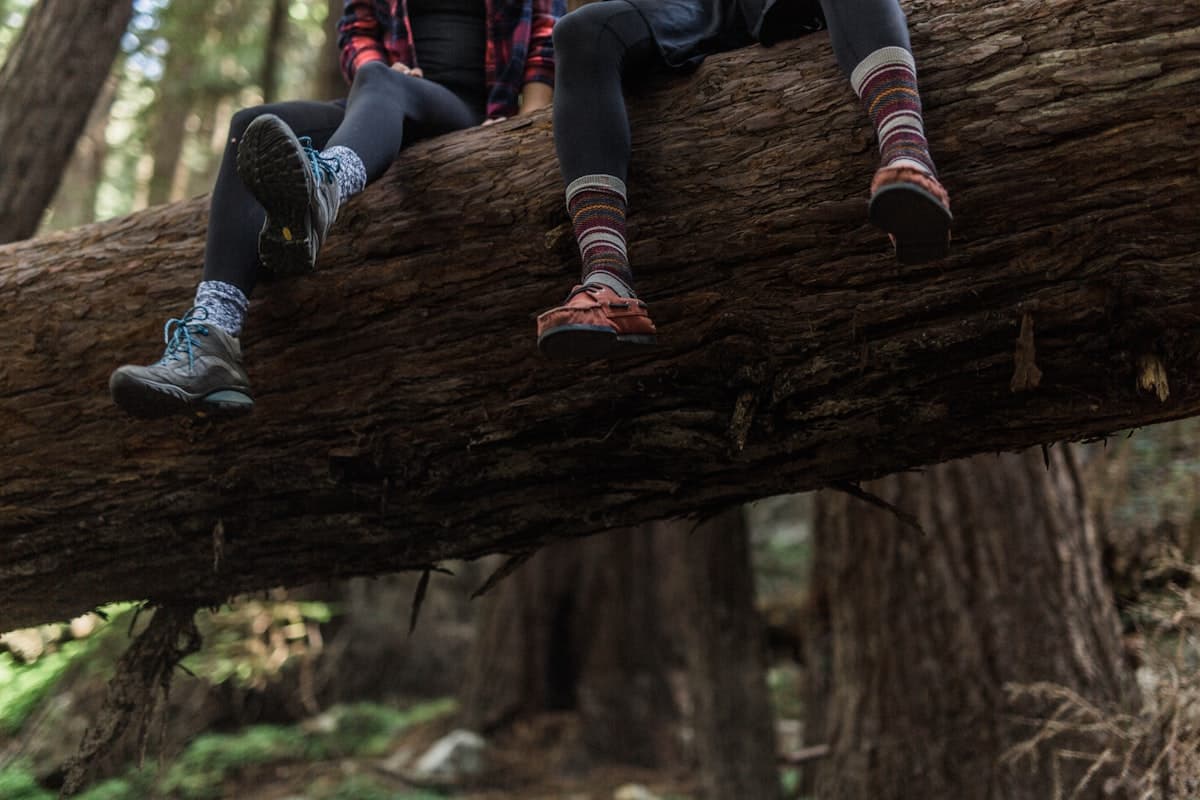
Hiking Socks Comparison: Merino Wool, Synthetic or Blend?
You spend hundreds on hiking boots, custom insoles and trekking poles. Then you shove on whatever socks are lying in the drawer. Result: blisters on your heel by kilometre five, soaked feet at the finish, and a deep sense of confusion about why hiking hurts so much.
The hiking sock is the most underrated piece of kit a hiker carries. It forms the interface between your foot and the boot — a zone where heat, moisture, friction and impact concentrate for hours on end. Poorly chosen, it causes more blisters than the boot itself. Well chosen, it turns a day of suffering into a comfortable outing.
This comparison gives you the tools to decide, with a selection of models tested in real conditions.
Why Socks Matter More Than Shoes
A blister is not caused by the boot. It's caused by repeated friction between the skin, the sock, and the boot's interior lining. The sock is the only element of that trinity you can easily change — and it plays three roles:
- Absorbing impact at the heel and forefoot (cushioning)
- Wicking moisture to keep the foot dry
- Reducing friction through fit and construction
A perfect boot with a poor sock creates blisters. A mediocre boot with an excellent sock often creates fewer problems. It's counterintuitive, but it's what hundreds of kilometres of field testing consistently shows.
The minimum entry point for hiking: a seamless-toe sock, with reinforced zones at the heel and toe, made from a breathable fibre. Everything else — material, height, thickness — depends on your conditions.
Merino Wool, Synthetic or Blend: What to Choose?
Merino Wool
Merino wool remains the benchmark for good reasons. It regulates temperature naturally — keeping you warm when it's cold and relatively comfortable as it warms up. It's naturally antibacterial: you can wear the same pair for two or three consecutive days without unpleasant odour, which is a game-changer on multi-day treks.
Its main weakness: durability. Pure wool wears quickly, especially at the heel and forefoot. This is why all quality merino socks are actually blends (80% merino + 20% nylon, for example).
The Smartwool Targeted Cushion is the reference model in this category. Built in mercerised merino wool with nylon at the wear zones, it offers targeted cushioning exactly where it matters: under the forefoot and at the heel. Starting from €23, it's the most tried-and-tested quality-to-durability ratio on the market.
Best for: versatile hikers, long multi-day treks, people sensitive to foot odour.
Synthetic
Polyester, nylon and their derivatives dry far faster than merino. After a river crossing, heavy rain or intense sweating, a synthetic sock returns to dry comfort within minutes. It also resists abrasion far better.
Its main drawback: odour. Synthetic fibres harbour bacteria, and after a few hours of walking, it shows. For day hikes, this isn't an issue. For a week-long trek, it becomes a genuine constraint.
Best for: day hikers, trail running, repeatedly wet conditions.
Blends
Most high-end hiking socks are merino/nylon/elastane blends. The goal is to combine merino's thermal regulation with synthetic's durability. This is the smart compromise for the vast majority of users.
The Falke TK2 perfectly illustrates this approach. Built in merino with precisely positioned polyamide reinforcements, it provides arch and Achilles tendon support that's felt from the first hours on the mountain. Starting from €11, it remains accessible.
Height and Thickness: Matching the Season and Terrain
Height
- No-show (below ankle): for lightweight trail shoes, short summer walks. Not recommended with high-cut boots — the boot's collar will rub directly on bare skin.
- Quarter (ankle height): the compromise for low to mid-height shoes.
- Crew (mid-calf): the reference for classic hiking. It rises high enough to protect from friction regardless of boot height.
- Full calf: for mountain hiking, long descents or wet conditions.
The simple rule: the sock must always extend above the boot collar. A millimetre of plastic or leather rim rubbing on bare skin over 25 kilometres is called a blister.
Thickness
- Ultra-light: for trail running, light summer outings, very snug-fitting shoes. Minimal cushioning.
- Light: for spring and autumn hikes with mid-season shoes. The best breathability-to-protection balance.
- Medium: for long rocky descents, mountain hiking, winter hiking boots. Caution: a sock that's too thick in a too-narrow shoe compresses the toes and cuts circulation.
In practice: light in summer, medium in spring and autumn, heavy-cushioned in winter or high altitude.
Seams and Reinforcement Zones: the Detail That Changes Everything
Toe Seams
This is where blisters are won or lost. A traditional toe seam creates a ridge. After five kilometres, that ridge has displaced your skin.
The best socks use one of two techniques:
- Hand-linked seam: seam sits flat against the toe, not as a ridge pressing into the skin.
- Seamless construction: the toe is knit in the round, with no junction. The best solution for sensitive feet.
Reinforcement Zones
Good reinforcement isn't just added thickness — it's a different weave, using more resistant fibres, precisely positioned where friction is most intense:
- Under the heel and at the Achilles tendon
- Under the forefoot (repeated impact with every step)
- Sometimes on the inner side (for pronating feet)
Arch Support
Several models incorporate circular elastic knitting under the arch. This support reduces micro-sliding of the sock inside the boot — the primary cause of blister formation. If you have flat feet or a collapsed arch, this is a criterion to prioritise.
Care and Real-World Durability
A quality hiking sock, properly cared for, lasts 300 to 500 kilometres. Here's how to get there:
- Wash at 30–40°C maximum (not 60°C like regular sports socks — merino wool shrinks).
- No fabric softener: it clogs fibres and destroys breathability.
- Air dry only, never in a tumble dryer (unless the label says otherwise).
- Turn the sock inside out before washing to protect the outer knit.
- Check the heel regularly: when the material thins significantly, the sock has had its day.
Darn Tough plays in a category of its own: it comes with a lifetime guarantee. The Vermont manufacturer will replace any worn-out pair free of charge, for any reason. Long-term, it's the most cost-effective investment — starting from €29.87.
Six Models by Use Case
Our selection covering every profile:
The Merino Reference — Smartwool Targeted Cushion
The timeless classic. Targeted cushioning, high-quality merino, available in several heights and weights. Ideal for mountain hiking across all seasons.
Technical Support — Falke TK2
Merino construction with polyamide zones. Integrated arch and Achilles tendon support. The best value-for-money pick in this selection for regular hiking.
Lifetime Guarantee — Darn Tough
Vermont brand, unconditional lifetime guarantee. Extreme durability, tight construction that resists abrasion on rocky trails. An investment, not an expense.
Waterproof — Bridgedale Storm Sock MW
The only waterproof sock in this selection. Integrated membrane for river crossings, heavy rain days or slushy snow. Reserve it for extreme conditions — breathability is lower by design.
Premium Merino — Icebreaker Hike+ Medium
Not currently available through our affiliate catalogue, but unmissable: the Icebreaker Hike+ is frequently cited as the finest long-distance trekking sock. Look for it directly at specialist outdoor retailers. Budget €25–35 per pair.
Budget — Decathlon Forclaz 100 and 500
For getting started or kitting out the whole family without overspending: Decathlon's Forclaz range offers honest quality from €4–8. The Forclaz 500 in merino wool deserves special mention. Best suited for hikes under 15 km with modest elevation gain.
The Size Trap
A sock that's too large makes folds. A fold means concentrated, constant friction. After two hours, that's a guaranteed blister.
Wear your exact size. If your shoe size falls at the boundary between two sock sizes (e.g. 42/43 on a 40–43 sock), go smaller if your boot fits snugly, larger if you wear thick insoles.
And double-up socks? Sometimes recommended to redistribute friction. But it doesn't replace a quality sock, and it compresses the foot in the boot if it wasn't designed for that. Use only in wide boots.
Conclusion
A hiking sock is not an accessory: it's technical gear. It protects your feet from friction, regulates temperature, wicks moisture and largely determines whether you finish the day smiling or limping.
Our main recommendations: the Falke TK2 for an accessible first choice, and the Smartwool Targeted Cushion for those who want to go straight to the best. The Darn Tough for those who want to buy once and forget about it.
To discover trails where you can test your new gear, head to OpenRando: thousands of verified GPX tracks, filterable by difficulty, elevation and region.
As an Amazon Associate, we earn from qualifying purchases. Links marked with an external icon are affiliate links.
Related reading
Best Portable Solar Panels for Hiking 2026
Power output, weight, durability, connectors: how to choose a portable solar panel for a day hike or a multi-day trek.
Hiking Sunglasses: How to Choose the Right Lens
Lens category, polarisation, photochromic, UV protection: how to choose hiking sunglasses for forest trails or high-altitude glaciers.
Hydration Systems for Hiking: Complete Comparison Guide
Stainless steel bottle, hydration bladder, filtered bottle or insulated flask: our complete comparison guide to choose the best hydration system for your hiking style.