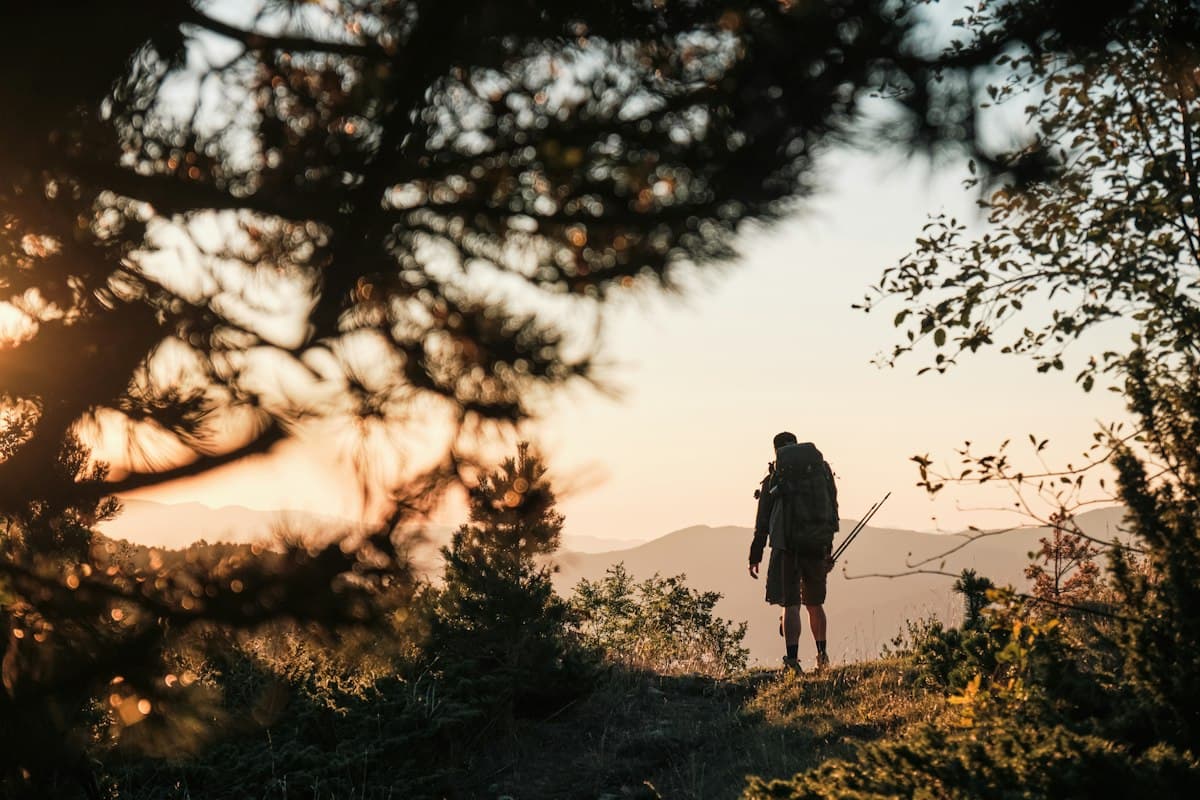
Hiking at Dawn: How to Plan a Sunrise Hike
Standing alone at a summit the moment the light ignites the horizon — it's one of the most powerful experiences hiking can offer. But a sunrise hike doesn't happen by chance. Departure time, weather, clothing for the cold, hiking in the dark: everything needs to be calculated, prepared and anticipated.
This guide gives you a concrete, number-based method so nothing is left to chance, whether you're targeting an Alpine summit, a Provençal ridge or a viewpoint in the Massif central.
1. Calculate Your Departure Time Backwards
This is where all planning starts. Most hikers make the mistake of calculating from the bottom up: "leave at 5am, arrive around 8am". The right approach is to reason backwards from sunrise.
The 4-Step Method
-
Look up the exact sunrise time for your date and location. Several websites give this to the minute. On 21 September 2026, the sun rises around 7:15am in Paris and 7:05am in Marseille.
-
Count your hiking time to the summit from the car park or trailhead, adding a 20% buffer on top of your usual estimate (tiredness from walking in the dark, less visible ground).
-
Add 15 to 20 minutes to set up your camera gear or simply wait at the summit before the sun appears.
-
Subtract this total from the sunrise time: that's your departure time.
Practical example: Sunrise at 7:05am at Sainte-Victoire (30 min walk from Château Noir car park). With 20% buffer: 36 min + 15 min waiting = 51 min. Latest departure: 6:14am.
2. Understanding the Three Phases of Dawn
Many hikers aim for "the sunrise" without distinguishing the different light phases that precede it. Yet each offers a radically different atmosphere.
Astronomical Twilight (about 90 min before sunrise)
The sky becomes imperceptibly brighter at the horizon. It's still pitch black. You'll need your headlamp at full power.
Nautical Twilight (about 60 min before)
Shapes can be made out without artificial light on open ground. Contrasts are soft. This is wildlife photographers' favourite moment: animals are active, light is neutral.
Civil Twilight (about 30 min before)
Light is sufficient to walk safely without a headlamp on a marked trail. The sky starts to turn colour. Often the most magical phase for hikers: that pink light that precedes the actual sunrise.
Actual Sunrise
The upper edge of the solar disc crosses the horizon. The light is golden, hard and horizontal. Shadows are very long. This phase lasts 5 to 10 minutes.
Knowing which phase you want to capture or experience helps you fine-tune your departure time. For arrival at civil twilight on a summit, aim to arrive 30 to 35 minutes before official sunrise.
3. Dressing for Three Temperatures
A sunrise hike takes you through three thermal environments in a few hours: the cool or cold night, the effort of climbing, and the warmth of post-sunrise morning. A 15°C swing between the depths of the night and mid-morning is not unusual in the mountains.
The Right Layer System
- Base layer: technical long-sleeved underwear, even in summer. Sweat cools you fast when you stop.
- Mid layer: thin fleece or a synthetic down gilet. Must be compressible and fit inside a 20 L pack.
- Windproof: essential. A lightweight packable windproof protects against ridge wind without weighing you down. From 400 m altitude, morning wind can drop the feels-like temperature by 5 to 8°C.
- Hat and gloves: even in summer above 1,500 m, extremities cool fast when you stop.
Common Mistakes
- Over-dressing at the start: you'll sweat heavily on the first climb and arrive at the summit in wet clothes.
- Neglecting your hands: holding a headlamp or operating a camera with numb fingers ruins the experience.
- Forgetting a warm hat: at a summit at 5am in wind, even in August, you'll wish you had one.
4. Hiking in the Dark: Headlamps and Navigation
Night hiking is a skill in its own right. It's not simply "day hiking with a torch". Terrain perception changes, distances are deceptive and waymarks become your only reference.
Choosing Your Headlamp
You don't need a construction-site floodlight. For a dawn hike on a marked trail, 200 to 300 lumens is enough for most paths. What matters more:
- Battery life: check it before leaving and carry spare batteries or a backup charger.
- Wide beam (flood) rather than narrow (spot): a spot beam is useful for seeing far but creates confusing shadow zones at the edges of the trail.
- Red mode: preserves night vision when you need to check a map or your phone.
Our guide to the best headlamps for hiking helps you choose based on your budget and use case. For more detail, see our full article: headlamp comparison for hiking.
Staying on Track in the Dark
- Download the GPX track before leaving onto your phone or a dedicated GPS device. In the dark, even a trail you know well can feel disorienting.
- Note key junctions mentally during a daytime recce if possible.
- Walk slower than usual: your brain processes fewer visual signals and compensates with extra caution.
- Stay on the marked trail: the temptation to cut through vegetation to "save time" is far more dangerous at night.
5. Choosing a Well-Oriented Summit
The summit choice may be the single most important decision. A beautiful sunrise missed because you were facing west means a wasted night march.
East-Facing View
To see the sun rise, you need an unobstructed view to the east from your summit. West-facing slopes, however beautiful, will remain in shadow for many more hours.
Ideal Conditions
- Partly cloudy skies are often better than a completely clear sky: clouds catch and reflect orange and pink colours. A fully overcast sky is disappointing.
- Moisture in the air (after a storm the previous evening, for example) intensifies colours.
- Little valley mist: a sea of clouds is stunning, but if it's too thick it blocks the light.
Reference Points in Provence
For readers in the region, here are three summits that reward the early start, all accessible from the car park in under 90 minutes:
- Mont Ventoux (eastern face): 360° panoramic view, horizon clear to the Alps. Browse itineraries from Bédoin on OpenRando
- Sainte-Victoire summit (from Pas du Moine): view over the Arc plain, the Durance and the Alpilles.
- Les Dentelles de Montmirail (Gigondas side): limestone ridges facing Ventoux, spectacular sunrise with shadow play on the rock.
For trails suited to night and twilight hiking across Provence, our guide to night trails in Provence lists the marked itineraries available.
6. Coming Back Down Without Lingering
The common mistake after a successful sunrise: staying too long at the summit, swept up in the emotion. Then descending in full sun, tired, on a path that heats up fast.
Rules for the Descent
- Eat and drink at the summit before heading down. Descent burns fewer calories but puts more strain on knees and ankles.
- Leave before the sun climbs too high: in summer, exposed trails after 10am become exhausting.
- Your pack weighs the same both ways: many hikers underestimate the descent because they feel they "went at dawn". The sleep deprivation is already there.
- Wear boots with good ankle support: sprains statistically happen more often on the way down, when concentration fades.
Protecting Your Knees
Descent is the main factor in joint wear. If you have a history of knee pain or you string together long outings, invest in telescopic poles: they reduce the load on your knees by around 30% during descents.
Summary: Your Sunrise Hike Checklist
Here are the 10 boxes to tick before your next dawn outing:
- Exact sunrise time looked up for your date and location
- Departure time calculated backwards (sunrise + hiking time + 20% buffer + 15 min waiting)
- GPX track downloaded on phone or GPS device
- Headlamp charged or with fresh batteries (+ spare batteries)
- Layered clothing: technical base + fleece + windproof + hat + gloves
- Water and food for the full round trip
- Weather checked the evening before and at 4am on the day
- Someone informed of your route and estimated return
- East-facing summit confirmed on a map or app
- Alarm set with margin: waking up in a panic guarantees a forgotten essential
With this preparation, a sunrise hike becomes one of the most memorable experiences the mountains have to offer. The dawn light alone is worth the lost hours of sleep.
Want to explore routes suited to this kind of outing? Browse hikes on OpenRando and filter by difficulty and elevation gain to find your ideal summit.
As an Amazon Associate, we earn from qualifying purchases. Links marked with an external icon are affiliate links.
Related reading
The Most Beautiful Night Hiking Trails in Provence
Night hiking in Provence: our favorite trails for walking under the stars, equipment tips, and everything you need to know for a successful nocturnal adventure.
How to Properly Fit Your Hiking Backpack: The Adjustment That Changes Everything
How to adjust your hiking backpack in the right order: hip belt, shoulder straps, load lifters, and sternum strap. The complete method in six steps.
How to Care for Your Hiking Boots: The Complete Guide
Cleaning, drying, waterproofing, leather conditioning: everything you need to know to maintain your hiking boots and make them last for years.