Wild Flowers of Provence: How to Identify Them While Hiking
Spring in Provence is far more than the iconic purple sweep of lavender fields. It is a rolling succession of floral carpets that invade the garrigue scrubland, limestone cliffs, oak woodlands and ridgeline paths: the vivid pink of cistus, the deep violet of wild orchids, the ghostly white of asphodels. Every hike becomes an open-air botany lesson.
But identifying these flowers is not always straightforward. How many times have you stopped beside an unknown plant and wished you could put a name to it? This guide gives you the keys to recognise the most emblematic wildflowers you will encounter on the trails of Provence, from the Luberon to the Alpilles, from the Sainte-Baume massif to the Calanques.
Why Provence is a botanical paradise
Provence's remarkable floral diversity stems from several converging factors. The Mediterranean climate — hot dry summers and mild wet winters — selects for drought-adapted plants: aromatic herbs, bulbous perennials, and species with thick or woolly leaves. The variety of habitats — low garrigue, pubescent oak forests, limestone cliffs, wetlands, transitional zones between coast and mountain — creates a mosaic of ecological niches. And the altitudinal gradient, from sea level to the Luberon's high ridges (Mourre Nègre, 1,125 m / 3,691 ft), generates very different conditions within just a few kilometres.
The optimal window for wildflower watching runs from mid-April to mid-June. This is when orchids peak, cistus covers the garrigue in waves of pink and white, and lavender begins pushing up in the higher zones.
10 emblematic wildflowers to recognise
Woolly rock-rose (Cistus albidus)
Impossible to miss on sunny limestone slopes: the woolly rock-rose bears large bright-pink five-petalled flowers whose crumpled appearance recalls crepe paper. It blooms from April onwards and smothers the hillsides of the Luberon and Alpilles in generous waves of colour.
How to identify it: Grey-silver leaves that are cottony to the touch, oval and stalkless. The petals drop each evening and are renewed each morning — a fascinating botanical quirk worth watching in situ.
Where to see it: The Bonnieux – Lacoste Village loop (10.9 km, 261 m elevation gain) winds through south-facing slopes carpeted in cistus in May, between olive trees and holm oaks.
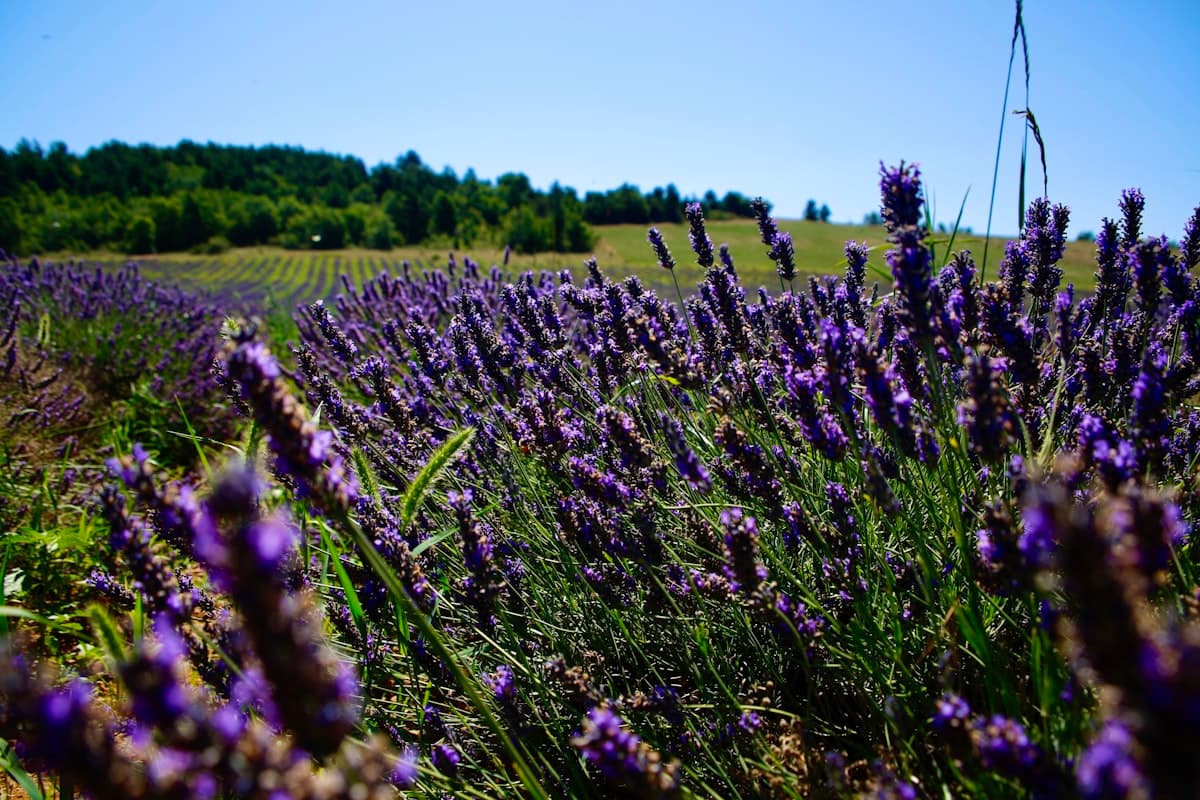
True lavender (Lavandula angustifolia)
The emblematic flower of Provence, yet few hikers can truly tell it apart from its relatives. True lavender — also called fine lavender — grows above 500 m on limestone plateaus: Valensole, Sault, the Claparède plateau in the Luberon. Lower down you will find lavandin, the cultivated hybrid grown for the perfume industry.
How to identify it: Unbranched stems at the base, long narrow grey-green leaves, intensely violet flower spikes. Tip: rub a leaf between your fingers — true lavender is far more aromatic than lavandin. It blooms from June to August depending on altitude.
Wild orchids
Provence is home to more than 60 species of wild orchids, making it one of France's richest regions for these plants. The most spectacular bloom between March and May on calcareous grasslands and garrigue edges.
Species to watch for:
- Bee orchid (Ophrys apifera): the labellum perfectly mimics a female bee to attract male pollinators.
- Mirror orchid (Ophrys speculum): metallic blue iridescent centre surrounded by brown fur, pollinated exclusively by a single species of solitary wasp.
- Pyramidal orchid (Anacamptis pyramidalis): tall stem topped by a dense pyramid-shaped spike of bright pink flowers, easily spotted from the trail.
- Lizard orchid (Himantoglossum hircinum): highly elongated twisted labellum, distinctive goat-like smell.
Important: Picking wild orchids is strictly prohibited — they are protected under French and European law.
On the Belvédère du Portalas and cedar forest loop from Bonnieux (11 km, 382 m elevation gain), the calcareous grasslands crossed by the trail provide ideal habitat for orchid watching in May.
Branched asphodel (Asphodelus ramosus)
The asphodel is one of the first flowers to herald spring across the garrigue. Its tall white stems, striped with pink, rise to a metre in height from March onwards, standing like candelabras across the scrubland.
How to identify it: Long triangular leaves clustered at the base, large star-shaped white flowers (6 tepals with a brown-pink midrib), arranged in a branched spike on a tall stem. The roots are spindle-shaped tubers that were once eaten as emergency food across Mediterranean regions.
Spiny broom (Calicotome spinosa)
From March to May, the garrigue blazes gold thanks to spiny broom. Its bright yellow pea-like flowers and rigid thorny branches form impenetrable thickets on rocky slopes — a useful reminder to stay on marked paths!
How to identify it: Heavily branching spiny shrub, small trifoliate deciduous leaves, axillary clusters of bright yellow flowers. Its delicate scent draws dozens of pollinator species.
Sage-leaved cistus (Cistus salviifolius)
The sage-leaved cistus cousin produces large white flowers with a golden centre, equally crumpled in appearance. It favours low garrigue and open woodland, often growing alongside rosemary and thyme.
How to tell it apart: Rough leaves resembling sage (hence the name), pure white flowers with a bright yellow centre. It blooms from April to June.
Common thyme (Thymus vulgaris)
An inseparable part of the Provençal garrigue, thyme flowers in small pale-pink to mauve tufts from April to June. It colonises the driest, poorest soils with enviable ease.
How to identify it: Small much-branched subshrub (20-30 cm), tiny leaves with inrolled margins (an adaptation to drought), tiny flowers clustered in terminal spikes. Powerful and characteristic scent triggered by the slightest touch.
Dwarf iris (Iris lutescens)
On the calcareous slopes of the Luberon and Alpilles, the dwarf iris flowers from March in intense violet or pale yellow. Too inconspicuous to be widely known, it is nonetheless one of the true jewels of Provençal flora.
How to identify it: Low-growing plant (10-20 cm), blue-green sword-like leaves, typical iris flower structure with 3 drooping sepals and 3 upright petals. It disappears rapidly after flowering, leaving only foliage.
Common poppy (Papaver rhoeas)
The poppy colonises fields, vineyards, path edges and disturbed ground. In May and June it floods parts of the Luberon plains and the Durance valley with blood-red colour, creating landscapes that recall Impressionist paintings.
How to identify it: Vivid red 4-petalled flowers, often with a black basal spot, hairy stem, deeply divided leaves. The fruit is a rounded capsule with small pores through which seeds disperse on the wind.
Old man's beard (Clematis vitalba)
In May, hedges and woodland edges are sometimes swamped by flowering clematis: a cascade of small cream-white flowers with a faint sweet scent. In autumn, the fluffy silvery seed heads earn it the poetic French name cheveux d'ange (angel's hair).
Best trails in the Luberon for wildflower watching
The Luberon concentrates exceptional botanical richness. These routes are particularly recommended in May for flower enthusiasts:
Mourre Nègre summit loop from Auribeau (10.3 km, 547 m elevation gain) — The path to the highest point of the Luberon passes successively through cistus and rosemary garrigue, calcareous grasslands rich in orchids, then lavender-covered moorland near the summit. The panoramic view over the Durance and the Alps from Mourre Nègre rewards the effort generously.
Portail de Chèvres loop with view over Bonnieux church (10 km, 230 m elevation gain) — A trail well suited to families, contouring the flower-covered slopes of the Petit Luberon between Bonnieux and Lacoste. Almond and cherry trees add their own floral touch in early spring.
Gorges de Véroncle and giant oak loop from Murs (9.2 km, 200 m elevation gain) — The Gorges de Véroncle form an exceptional plant corridor — shaded and humid — where ferns grow alongside orchids and dwarf irises. A striking contrast with the dry garrigue above.
Goult – Jerusalem Mill loop (4.6 km, 189 m elevation gain) — The most accessible option. This short circuit around the village of Goult is ideal for a first family botany walk, on well-marked paths through the flowering garrigue of the central Luberon.
Browse all these hikes and many more on the OpenRando Explore page.
Essential tools for identifying flowers in the field
A well-prepared botanical walk makes all the difference:
- The PlantNet app: free and highly effective for Mediterranean flora, it identifies plants from a smartphone photograph. A genuine revolution for amateur botanists.
- A botanical field guide: nothing replaces a good illustrated book for understanding plant families and developing an observational method. A guide specialising in Mediterranean flora is particularly useful in Provence.
- A ×10 magnifying loupe: essential for observing the fine details of orchid flowers (column, labellum, pollinia), leaf hairs or microscopic structures that distinguish similar species.
- A nature notebook: jotting down the date, location, altitude, aspect and observed characteristics will help you progress from one outing to the next, building your own personal flora over the seasons.
How to enjoy wildflowers without damaging them
Provence's botanical heritage is fragile, threatened by trampling, picking and habitat fragmentation. A few simple habits help protect it:
- Never pick wild orchids — they are protected by law and may take years to produce their first flower.
- Stay on marked paths in botanically sensitive areas (calcareous grasslands, wetlands, orchid meadows).
- Do not move stones — many plants germinate in the moisture found beneath them.
- Photograph rather than pick — a photo lasts years, a bouquet a few hours.
- Share your observations on platforms like iNaturalist or PlantNet to contribute to biodiversity mapping.
Hiking in Provence with a botanical eye transforms the experience entirely. Every kilometre becomes a biodiversity lesson, an invitation to slow down and notice what grows just off the path. Come back to the same trails year after year — and each time, you will see something new.
To plan your next spring outing, also read our guide on hiking in Provence in spring and explore the 10 unmissable hikes around Aix-en-Provence.
As an Amazon Associate, we earn from qualifying purchases. Links marked with an external icon are affiliate links.
Related reading
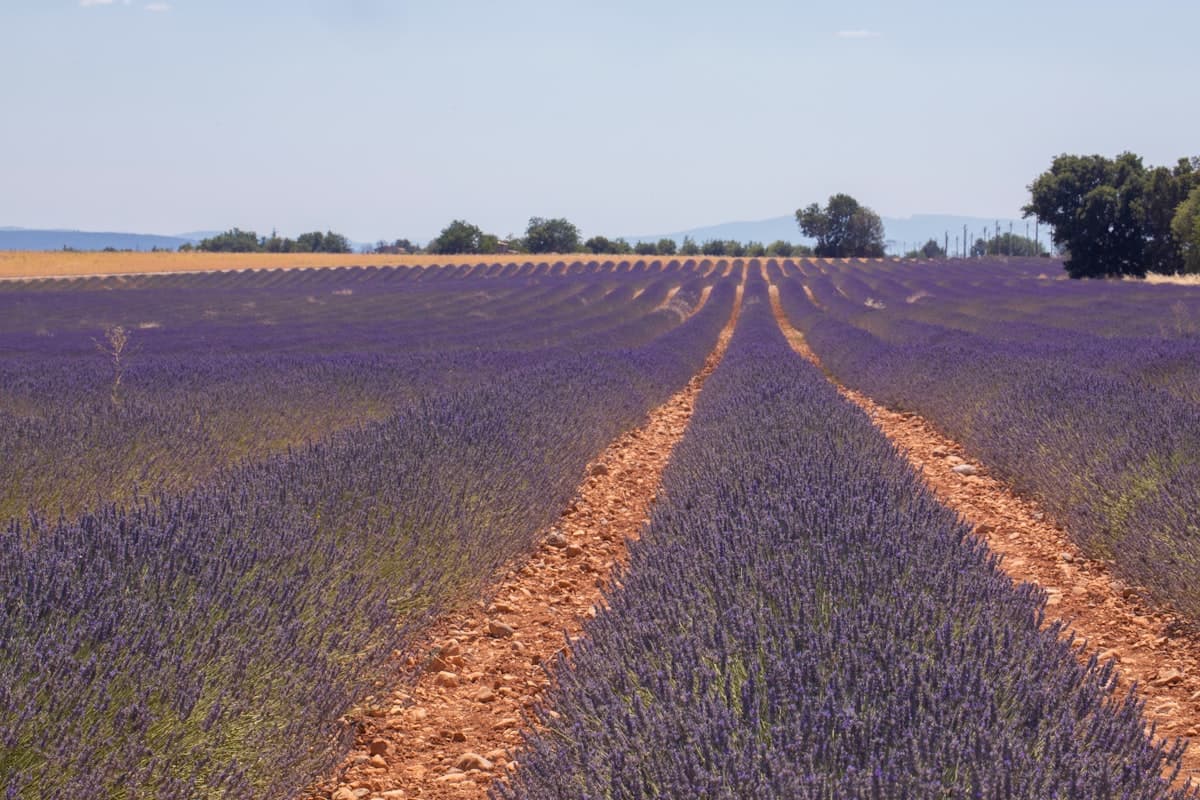
Spring hiking in Provence: 5 flower-filled trails
5 hikes to enjoy spring in Provence: Alpilles, Luberon, Colorado Provencal, Garlaban and Saint-Remy. Blooming garrigue, fragrances and golden light.
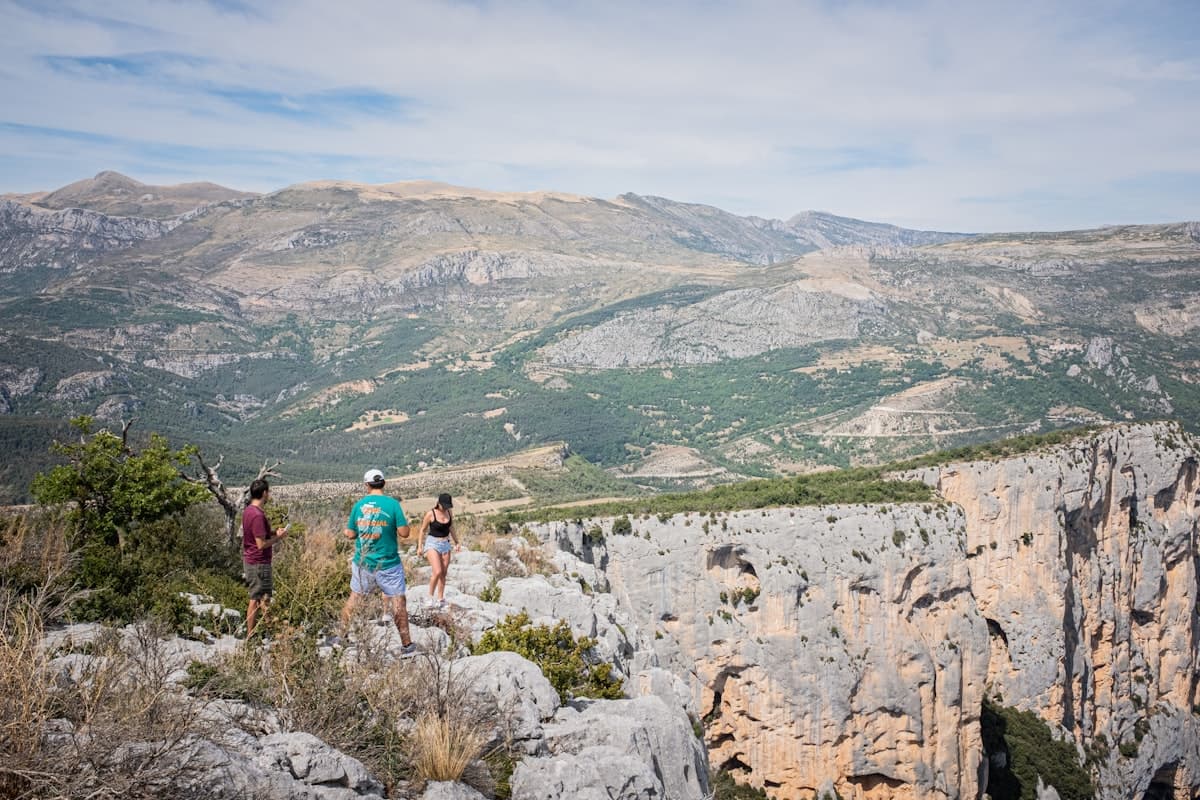
Where to Hike During the May Bank Holidays 2026? Our Best Ideas in Provence
Four May bank holidays, four chances to hike in Provence and southern France. Our selection of trails for each long weekend: Calanques, Verdon, Luberon, Côte Bleue and Sainte-Baume.

8 Hikes for Your Easter Holidays in Provence
Easter is the perfect season to hike in Provence: mild temperatures, wildflowers in bloom, and trails before the summer crowds arrive. Here are 8 unmissable itineraries, from the Calanques to the Gard, the Luberon to the Var.