What to Pack in Your Hiking First Aid Kit: The Complete Guide
A twisted ankle on a rocky trail, a blister after two hours of walking, an insect sting that swells more than expected, a cut on a rock while crossing a stream… Minor injuries are common when hiking. And when you're an hour's walk from the car, only one question matters: do I have what I need to treat it on the spot?
A well-prepared first aid kit weighs just 200 to 400 grams and can turn a ruined day into a mere anecdote. Yet far too many hikers still head out with nothing or with an expired kit pulled from the back of a drawer. This guide tells you exactly what to pack, how to organize your kit, and what first aid skills to know so you can respond effectively on the trail.
Why Carry a First Aid Kit When Hiking?
The answer seems obvious, but the numbers speak for themselves: in France alone, mountain rescue teams respond to over 17,000 calls per year, and the majority of incidents involve hikers. The most common injuries aren't dramatic fractures but rather sprains, blisters, heatstroke, and minor cuts that could have been managed on-site with basic supplies.
Carrying a first aid kit means:
- Being able to treat minor injuries without cutting the hike short
- Preventing small problems from getting worse (an unprotected blister becomes an open wound)
- Buying time in case of a more serious problem, while waiting for rescue
- Reassuring the group, especially when hiking with children and family
The Must-Haves: Essential Items
Here's the basic kit that every hiking first aid kit should contain. This covers 90% of common trail situations.
Wound Care
- Sterile gauze pads (5 to 10 pieces, 10×10 cm) — for cleaning and protecting wounds
- Antiseptic wipes or single-dose sachets — more hygienic and lighter than a bottle
- Assorted adhesive bandages — several sizes, including long strips for fingers
- Microporous tape (2.5 cm wide roll) — to secure gauze and bandages
- Adhesive wound closure strips (Steri-Strips) — to close a deep cut while awaiting proper care
- Compact scissors or a small knife (the one on your Swiss army knife works fine)
Blister Prevention and Treatment
Blisters are the number one plague of hikers. Even with proper hiking boots, they can appear on long hikes or in hot weather.
- Hydrocolloid blister patches (such as Compeed) — apply at the first sign of rubbing, BEFORE the blister forms
- Elastic adhesive tape — to protect friction zones
- Specialized hiking blister plasters — a non-negotiable item in any kit
Trauma and Pain Relief
- Elastic support bandage (8 cm wide) — to strap an ankle or knee in case of a sprain
- Flexible splint or SAM Splint (foldable, lightweight) — useful for long or remote hikes
- Painkillers: paracetamol (acetaminophen) and ibuprofen — check expiry dates regularly
- Instant cold pack — activated by squeezing, no refrigerator needed
Protection and Survival
- Emergency survival blanket (one gold side, one silver side) — against hypothermia or sunstroke, weighs under 50 g
- Tweezers — for removing splinters and ticks
- Tick remover tool — essential in tick-prone areas (forests, scrubland)
- Whistle — to signal for help in an emergency (the international distress signal is 6 blasts per minute)
Going Further: Adapt Your Kit to the Terrain and Season
The basic kit covers most situations, but depending on your destination and the season, some additions are worthwhile.
In Summer and Under the Southern Sun
If you're hiking in Provence — in the Calanques, the Luberon, or the Gorges du Verdon — sun and heat are your main enemies.
- High-protection sunscreen (SPF 50) in a small format
- SPF 50 lip balm — lips burn quickly at altitude
- Single-dose saline solution — to rinse eyes in case of dust or sweat
- Oral rehydration salts — in case of heatstroke or dehydration
In Tick and Insect Zones
In the Provençal scrublands, the Drôme, or the Vercors, ticks are particularly active in spring and autumn.
- Tick remover tool (if not already in your essentials)
- Antihistamine cream — for itchy insect bites
- Venom extractor pump — debated in effectiveness, but reassuring to carry
- Anti-tick repellent spray — apply to clothing and skin before setting off
In the Mountains and Cold Weather
For hikes at altitude in the Alps of Haute-Provence or the Mercantour:
- Extra emergency blanket — cold at altitude can catch you off guard even in summer
- Haemostatic dressings — in case of heavy bleeding when rescue may take time to arrive
- Altitude sickness medication — above 2,500 m, worth packing if you're susceptible
Organizing Your Kit: Best Practices
Having the right gear isn't enough. You also need to be able to find it quickly when you need it — sometimes in the rain, with shaking hands.
Choosing the Right Container
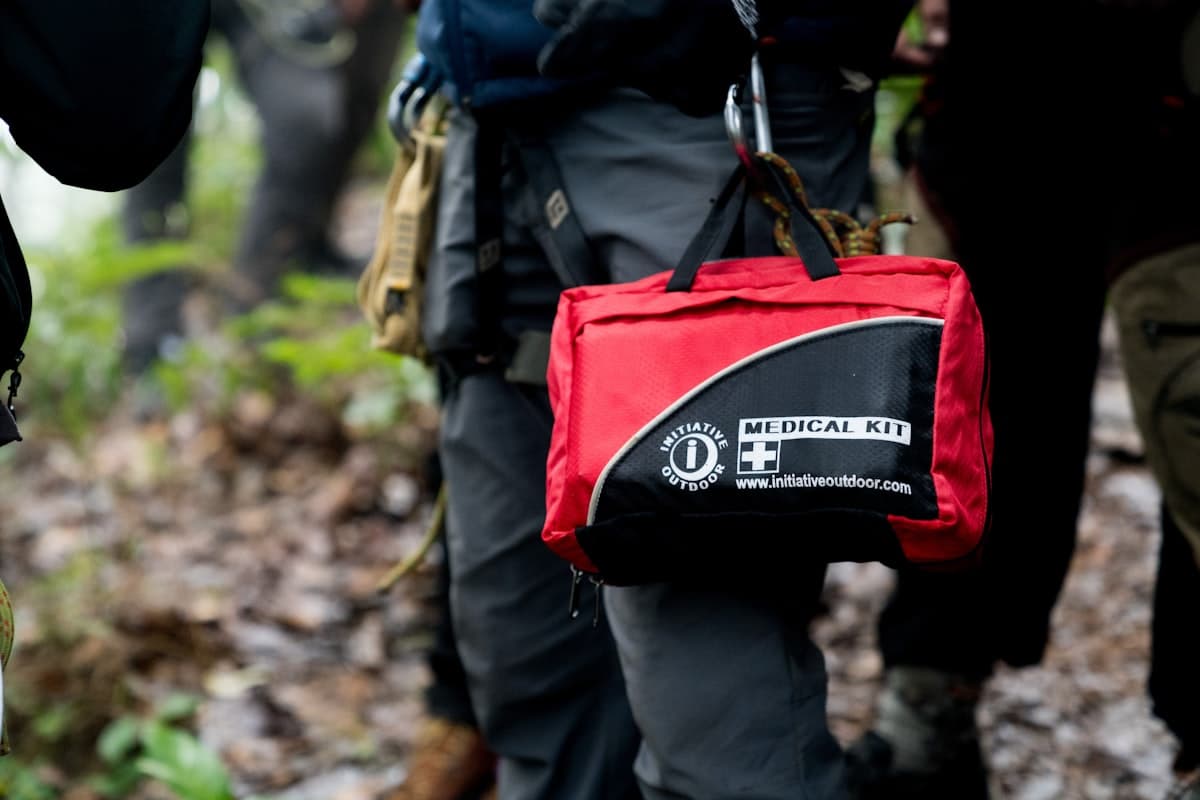
Go for a waterproof, compact pouch, ideally with internal compartments. Key criteria:
- Waterproofing — a soaked kit with damp gauze is useless
- Visibility — bright colour (red, orange) to find it quickly in your backpack
- Compactness — the kit should fit in a side pocket, not at the bottom of your pack
- Reliable closure — waterproof zip or Velcro, not a snap button that pops open
Where to Store the Kit in Your Pack
This is crucial: the kit must be immediately accessible, without having to empty your entire pack. The best spots:
- Top lid pocket — quick access, even with the pack still on your back
- Side pocket — visible and accessible
- Never at the bottom — in an emergency, every second counts
Check and Refresh Regularly
A first aid kit isn't something you prepare once and forget about. Before each hiking season:
- Check expiry dates on medication and sterile gauze
- Replace anything you used on the last outing
- Adjust the contents for the season and destination
- Test that closures work and the pouch is still waterproof
Essential First Aid Skills to Know
Having a kit is great. Knowing how to use it is better. Here are the essential skills every hiker should master.
Dealing with an Ankle Sprain
Sprains are the most common injury when hiking, especially on technical trails or during descents.
- Stop immediately — never push through on a painful ankle
- Apply the cold pack for 15 to 20 minutes
- Strap the ankle with the support bandage in a U-shape (under the foot, up each side)
- Assess severity — if you can't bear weight, call for help (112 in Europe, 911 in North America)
- If you can still walk, shorten your route and head for the nearest exit point using your GPX file as a guide
Dealing with Heatstroke
Common in summer in southern France, especially in exposed areas like ridgelines or scrubland.
- Move the person into shade immediately
- Lay them down and elevate their legs
- Cool them by wetting their face, neck, and wrists with water
- Have them drink in small sips (water + rehydration salts if available)
- Use the survival blanket with the silver side facing out to reflect heat
- If confusion or loss of consciousness occurs: call 112 immediately
Dealing with a Tick Bite
Ticks can transmit Lyme disease. They must be removed as quickly as possible.
- Use the tick remover tool by twisting gently (never pull straight, never apply chemicals)
- Disinfect the area with a gauze pad and antiseptic
- Note the date and location of the bite
- Monitor for 30 days: if a circular redness appears around the bite site (erythema migrans), see a doctor promptly
Dealing with an Open Wound
- Wash your hands or use hand sanitizer
- Clean the wound with clean water or saline solution
- Disinfect with a gauze pad soaked in antiseptic (from inside to outside)
- Close the edges with Steri-Strips if the cut is deep
- Cover with a bandage appropriate for the wound size
- If bleeding doesn't stop: apply firm pressure with gauze pads and call 112
Emergency Numbers to Know
Save these numbers in your phone before heading out:
- 112 — European emergency number (works everywhere, even without your carrier's network)
- 911 — North American emergency number
- In France: 15 — SAMU (medical emergencies)
- In France: 114 — emergency SMS number (if you can't speak)
In areas with no mobile signal, your whistle is your best friend. The international distress signal is 6 whistle blasts per minute (one every 10 seconds), followed by one minute of silence, then repeat.
Pre-Made Kit vs. DIY: Which Is Best?
Pre-made kits
The advantage of ready-made first aid kits is that they contain the essentials in an optimized pouch, often for under €25 / $30. They're perfect for beginners who don't want to overthink it.
Drawbacks: they sometimes include unnecessary items (a CPR face shield rarely used) and often lack blister plasters or a tick remover.
Building Your Own Kit
This is the best option for regular hikers. Buy items individually at a pharmacy and build a kit tailored to your needs. You control the contents, the weight, and the quality of each item.
Our tip: start with a ready-made kit, remove what's unnecessary, and add what's missing (blister plasters, tick remover, personal medication).
The Complete Checklist
Here's a summary of everything your hiking first aid kit should contain. Print this list or save it on your phone.
Essentials (always in the kit):
- Sterile gauze pads (x5 to x10)
- Antiseptic wipes/sachets
- Assorted adhesive bandages
- Blister plasters (x4)
- Microporous tape
- Steri-Strips
- Elastic support bandage
- Paracetamol and ibuprofen
- Instant cold pack
- Emergency survival blanket
- Tweezers and tick remover
- Emergency whistle
- Small scissors
Seasonal additions:
- Sunscreen and SPF 50 lip balm
- Rehydration salts
- Saline solution
- Anti-tick spray / antihistamine cream
- Haemostatic dressings (mountains)
Bonus items:
- Hand sanitizer (small format)
- Safety pins (x2) — to improvise a sling from a scarf
- Laminated first aid reference card
- Personal medication (allergy, asthma…)
Conclusion
A well-prepared first aid kit is a bit like insurance: you hope you'll never need it, but the day you do, you're incredibly grateful you packed it. For a few dozen euros and less than 400 grams in your pack, you set off with peace of mind and protect everyone who hikes with you.
Before your next outing, take 15 minutes to check your kit. And if you don't have one yet, now's the time. Browse our hiking trails to plan your next adventure with confidence.
As an Amazon Associate, we earn from qualifying purchases. Links marked with an external icon are affiliate links.
Related reading
Ticks and Insects While Hiking: The Complete Protection Guide
Ticks, mosquitoes, horseflies, harvest mites, hornets... Learn how to identify the risks, protect yourself effectively and react in case of a bite during your forest and garrigue hikes.
Protecting Your Skin While Hiking: Sun, Wind and Cold
Sunburn, chapping, dryness: a hiker's skin endures sun, wind and cold far more than that of city dwellers. Here's how to protect it effectively all year round.
How to Purify Water While Hiking: The 4 Methods Compared
Filter, tablets, UV or boiling: the four methods for purifying water while hiking, what they actually eliminate, and which one to choose.