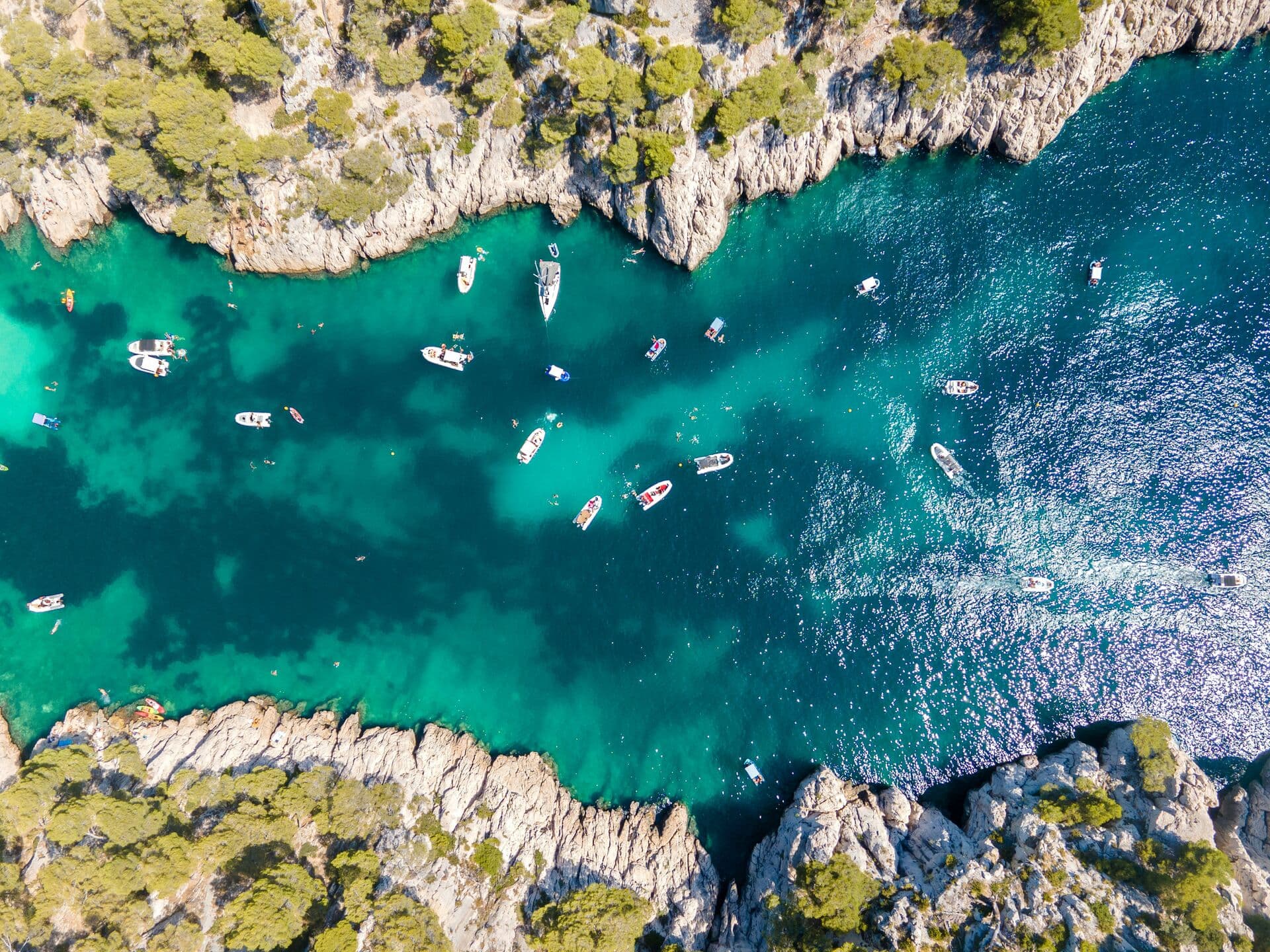
Marseille Hiking: 10 Trails Beyond the Calanques
The Calanques are spectacular. But if you live in Marseille or are spending a few days there, you'll quickly realize that France's second-largest city is surrounded by far more natural landscapes than just its famous national park. From the Garlaban hills beloved by Marcel Pagnol to the pristine Blue Coast, from the wild ridges of Carpiagne to the urban trails of the Old Port district — Marseille is encircled by a network of hiking routes that most visitors never discover.
Here are 10 hikes around Marseille that venture well beyond the Calanques. Raw nature, unexpected panoramas, history-laden landscapes — these trails will show you France's second city from a completely different angle.
1. Fort Saint-Jean – Le Panier: The Urban Hike
Distance: 17.7 km | Elevation gain: +233 m | Level: Easy | Duration: 4h30
This unusual loop combines heritage sightseeing — the Old Port, Fort Saint-Jean, and the Panier district — with a traverse of Marseille's elevated neighbourhoods. You'll weave through forgotten alleyways and staircases that connect the hilltop quarters, with sweeping views over the harbour and the Rade de Marseille.
The Panier, Marseille's oldest neighbourhood, offers unexpected panoramas over Notre-Dame de la Garde and the Frioul islands. Perfect for heritage lovers, families, or overcast days when the wild countryside is less appealing.
2. Vallon des Auffes – Roucas Blanc: The Seafront Walk
Distance: 12.8 km | Elevation gain: +80 m | Level: Very easy | Duration: 3h
The Vallon des Auffes is one of the last fishing villages embedded within a major city. From here, the loop follows the iconic Corniche Kennedy — Marseille's elegant seafront promenade — through to the residential Roucas Blanc neighbourhood and on to Prado Beach.
A gentle, nearly flat route perfect for families or beginners who want to experience Marseille from the sea side without strenuous effort. Sunsets from the Corniche are among the most beautiful in the city.
3. Blue Coast: Figuerolles Beach and the Jonquier Viaduct from Le Rove
Distance: 15.4 km | Elevation gain: +329 m | Level: Intermediate | Duration: 4h30
Northwest of Marseille, the Côte Bleue (Blue Coast) feels more like Croatia than Provence: hidden coves, white limestone cliffs dropping into crystal-clear water, and preserved fishing villages. Figuerolles beach, accessible only on foot or by boat, is one of the finest in the entire region.
The loop from Le Rove climbs to the Jonquier Viaduct — an impressive remnant of a disused railway line — before descending to Figuerolles along a coastal path. The return offers spectacular views over the Mediterranean and the Chaîne de la Nerthe massif. A hidden gem that few tourists ever find.
4. Jonquier Viaduct Loop from Gipier
Distance: 11.3 km | Elevation gain: +284 m | Level: Intermediate | Duration: 3h30
A shorter variant of the previous circuit, ideal for a half-day outing. Starting from impasse du Gipier skips the more urban opening section and plunges you straight into coastal scrubland. You reach Figuerolles faster, leaving enough time to enjoy the beach before the return.
5. Le Garlaban: In Marcel Pagnol's Footsteps
Distance: 14.7 km | Elevation gain: +570 m | Level: Intermediate | Duration: 5h
The Garlaban massif is Marcel Pagnol's country. These rugged hills between Aubagne and Marseille were the backdrop to the legendary French author's novels and films. The Grotte du Cerf, the Tête du Garlaban summit (714 m), the Barres du Saint-Esprit ridgeline — every landmark resonates with his stories.
The loop from Camp Major crosses fragrant garrigue scrubland before reaching the Garlaban summit, which delivers a 360° panorama: Marseille and its bay to the southwest, Montagne Sainte-Victoire to the northeast, and the endless Provençal plain stretching towards the Alps on clear days.
Highlight: the view from the summit, with Marseille shimmering below and the blue Mediterranean reaching to the horizon. Bring compact binoculars to pick out the details of the harbour.
6. Allauch – Grotte du Gros Hibou
Distance: 11.5 km | Elevation gain: +425 m | Level: Intermediate | Duration: 4h
The village of Allauch, right on Marseille's doorstep, is the starting point for this loop exploring the foothills of the Garlaban. The Grotte du Gros Hibou (Big Owl Cave), a natural cavity in the limestone, is the highlight — reached via a steep but well-marked trail.
Allauch itself is worth an hour of exploration: its restored windmills, medieval alleyways and panoramic views over the Chaîne de l'Étoile make it one of the most charming villages in the Marseille metropolitan area, yet it's only 15 minutes from the city centre.
7. Mont Carpiagne – Mont Saint-Cyr: The Summit Challenge
Distance: 14.0 km | Elevation gain: +635 m | Level: Difficult | Duration: 5h30
The Carpiagne massif, wedged between the Calanques and the Aubagne plain, is one of the wildest areas in the Marseille hinterland. The loop from La Barasse links Mont Carpiagne (646 m) and Mont Saint-Cyr (529 m) — two summits with radically different outlooks. The first looks down on Marseille's harbour and islands; the second surveys the Garlaban massif and Sainte-Victoire.
A route for experienced hikers, with significant elevation gain and rocky passages. Bring trekking poles for the steep descents — they'll make a real difference on your knees.
8. La Chaîne de l'Étoile: Marseille's Northern Roof
Distance: ~12 km | Elevation gain: +500 m | Level: Intermediate | Duration: 4h
North of Marseille, the Chaîne de l'Étoile forms a limestone ridge that peaks at the Signal de l'Étoile (779 m). The panorama is breathtaking: Marseille and the sea on one side, the Étang de Berre lagoon and the Arc Valley on the other.
The usual approach is from Simiane-Collongue or Gardanne. The trail follows an exposed ridgeline — beware the mistral wind, which can be fierce — before reaching the summit. Far less visited than the Calanques, this is a favourite among Marseillais who know their city's wild surroundings.
9. La Nerthe: Between Marseille and the Berre Lagoon
Distance: ~10 km | Elevation gain: +300 m | Level: Easy to intermediate | Duration: 3h
The Chaîne de la Nerthe separates Marseille from the Étang de Berre lagoon. From the Estaque neighbourhood, little-used paths climb to the ridge, with alternating views over Marseille's harbour and the lagoon. An ideal quick escape from the city, accessible by RTM bus from the centre.
The Estaque district itself is worth a detour: Cézanne and Braque both painted here, and its fishermen's shacks have retained a rare authenticity in an increasingly gentrified city.
10. The Marseilleveyre Hills
Distance: ~11 km | Elevation gain: +450 m | Level: Intermediate | Duration: 3h30
Marseilleveyre (432 m) is the highest point immediately south of Marseille, right on the edge of the Calanques National Park. By approaching from Mazargues rather than the classic Calanques trailheads at Luminy or La Cayolle, you bypass the crowds entirely and discover the massif from a fresh angle. The view from the summit over the harbour and the islands — Pomègues, Ratonneau, and the Château d'If — is stunning.
Practical tips for hiking around Marseille
When to go?
Spring (March to June) and autumn (September to November) are the best seasons. In summer, intense heat and wildfire risk make many areas dangerous or closed by prefectural decree. Always check current closures before heading out.
Fire risk
This is the number-one factor around Marseille. Between June and September, the Bouches-du-Rhône prefecture publishes daily fire risk bulletins. At red or black risk levels, many trails close without notice. Check the prefecture's website or the Météo-France app before any summer outing.
Water
Almost all massifs around Marseille have no water sources along the trail. Always carry a minimum of 2 litres per person. For hikes longer than 4 hours or in summer, a 2-litre filter bottle adds a useful safety margin.
Public transport
An underrated advantage of hiking around Marseille: the RTM bus network gives access to many trailheads without a car. Key lines serve Allauch, La Barasse (Carpiagne starting point) and several Blue Coast villages. Check the RTM website before planning your outing.
Conclusion
Marseille is far more than a gateway to the Calanques. Its limestone hinterland, wooded massifs, pristine northern coastline and panoramic ridges offer dozens of varied hikes, often deserted on weekdays. Whether you're a city dweller seeking fresh air or a travelling hiker passing through, these 10 routes promise a different Marseille — wild, authentic, and often reachable by bus from the city centre.
To plan your outings with GPX tracks and detailed trail information, explore all available routes around Marseille on OpenRando.
As an Amazon Associate, we earn from qualifying purchases. Links marked with an external icon are affiliate links.
Related reading
Hiking During Hunting Season: How to Stay Safe in Autumn
How to hike safely during hunting season in France: know the hunting dates by region, how to spot an active drive hunt, how to stay visible, and what to do if you encounter a battue.
The Best Hikes in the Vosges Mountains
Eight hikes in the Vosges: summits, glacial lakes, highland meadows and ridge trails, through France's most spectacular autumn beech forests.
Hiking in the Fog: Safety, Navigation and Techniques to Stay on Track
Hiking in fog and mist: how to hold your bearing, assess visibility in meters, avoid disorientation and know when to turn back.