Wildlife to Spot While Hiking in Provence
Walking through Provence means crossing a mosaic of habitats — garrigue scrubland, pine forests, calanques, gorges, high plateaus — each home to surprisingly varied wildlife. Most animals go unnoticed by rushed hikers, but a few minutes of silent attention can turn an ordinary outing into a memorable observation moment.
This guide reviews the main species to know, the habitats where to find them, and best practices for watching without disturbing. Bring binoculars, slow down, and open your ears.
Large mammals
Wild boar: omnipresent and nocturnal
Wild boar (Sus scrofa) is the most abundant and least shy animal in Provence. You'll see traces everywhere: prints, rooting patches, wallows. On the trail, they appear mostly at dawn or dusk, alone or in groups of sows followed by their piglets. Wild boar isn't spontaneously aggressive, but a sow protecting young may charge. Keep your distance, don't run, walk around slowly.
Corsican mouflon: king of the rocky terrain
Introduced in the 1950s on several massifs (Sainte-Baume, Sainte-Victoire, Mont Caume), the mouflon (Ovis aries musimon) has colonised limestone rocky areas. Males, recognisable by their spiralled horns, live in herds separate from females outside the autumn rut. Observe them on crests and scree at sunrise. Approach against the wind and discreetly — their eyesight is excellent.
Roe deer and red deer
More discreet, these cervids live in northern wooded massifs (Mercantour, Préalpes, northern Luberon). Roe deer bark when they feel threatened — a sharp, brief sound that startles the first time. Red deer bellow in September–October: an unforgettable acoustic spectacle to listen for at dusk on the heights.
Ibex and chamois
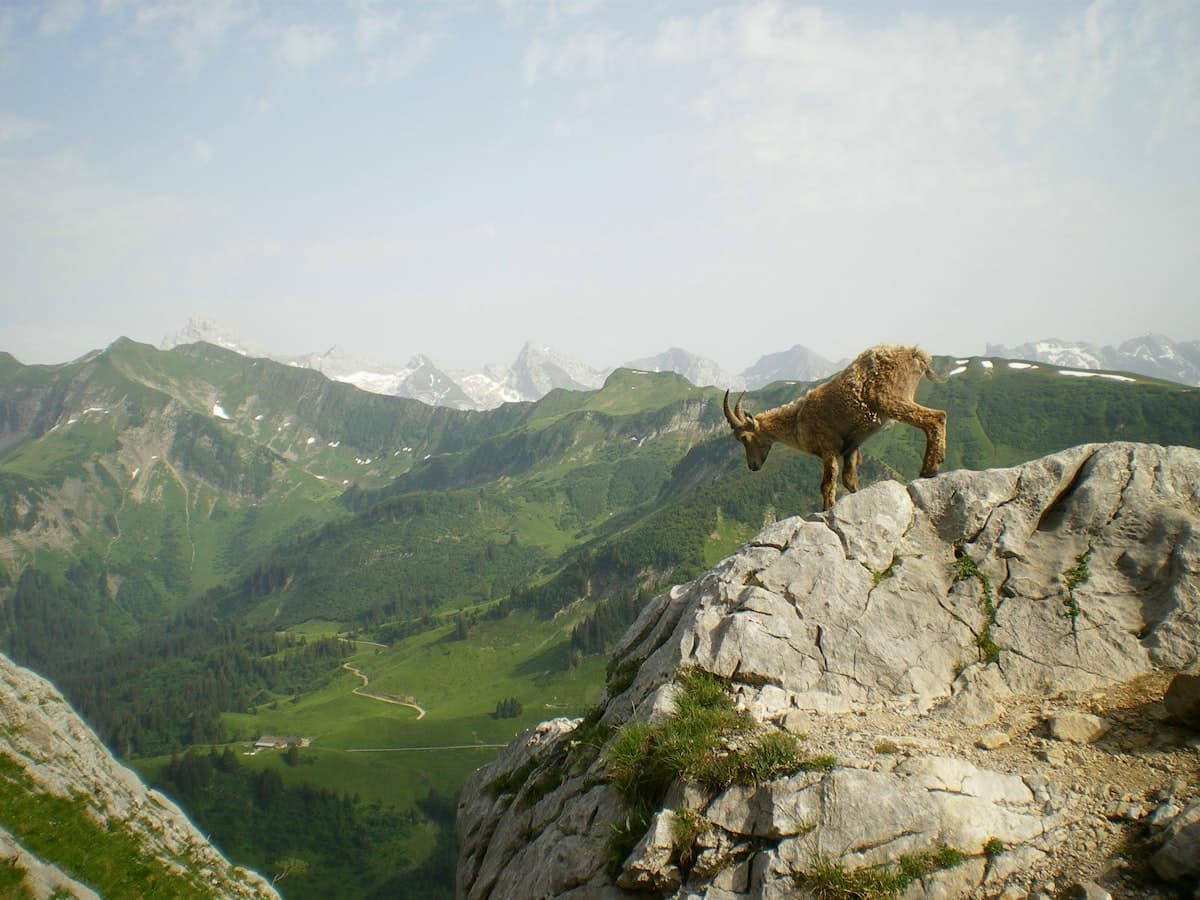
Confined to the high altitudes of Mercantour and Écrins, these two species let you approach on alpine pasture trails. Ibex, fairly tame, can tolerate a 10–20 metre distance. Chamois, shyer, flee as soon as they spot you.
Raptors: masters of Provençal skies
Bonelli's eagle: an endangered star
Bonelli's eagle (Aquila fasciata) is one of France's most emblematic and threatened species — fewer than 40 breeding pairs nationwide, most in PACA region. It nests in the limestone cliffs of the Calanques, Alpilles and Verdon. Recognisable by its powerful flight and pale underwings marked with a dark band, it patrols the garrigue hunting rabbits and partridges.
Griffon vulture: spectacular return
Reintroduced in the 1990s in the Verdon, the griffon vulture (Gyps fulvus) now counts several hundred pairs in the gorges. With a 2.80 m wingspan, it's impossible to miss. Best viewpoints are the Grand Canyon belvederes (Point Sublime, Route des Crêtes).
Other common raptors
- Common kestrel: very widespread, identifiable by its hovering flight over fields.
- Sparrowhawk: small-bird hunter, fast and low flight in undergrowth.
- Common buzzard: most frequent raptor, perched on fence posts or circling in thermals.
- Short-toed snake eagle: reptile specialist, glider with a pale silhouette.
Birds of the garrigue and pine forests
Provence is a Mediterranean ornithology hotspot. Spring hikes (April–June) are particularly rich in song and observations.
- Sardinian warbler: small black-capped passerine, very vocal in the garrigue.
- Hoopoe: spectacular colours, butterfly-like flight, lives in cultivated and open areas.
- European roller: vivid turquoise blue, African migrant present from April to August.
- European bee-eater: nests in colonies in sandy riverbanks (Camargue, Durance).
- Shrike: impales prey on thorns, look for them in open agricultural zones.
- Chaffinch and Eurasian jay: familiar inhabitants of Provençal pine forests.
For enthusiasts, the Camargue remains one of Europe's greatest ornithological sanctuaries: flamingos, herons, stilts, glossy ibis, terns…
Reptiles and amphibians
Provence's hot dry limestone terrain is a paradise for reptiles.
Snakes: rare but worth knowing
- Montpellier snake: Europe's largest colubrid (up to 2 m), harmless to humans.
- Viperine snake: aquatic, near water bodies, completely harmless.
- Asp viper: the only regularly encountered venomous snake in Provence. Recognisable by triangular head and stout body. Rarely aggressive, bites only if cornered. Never walk barefoot in garrigue; shake out shoes left outside overnight.
Lizards and tortoises
- Ocellated lizard: Europe's largest lizard (up to 60 cm), magnificently dotted with blue. Protected species, observe respectfully.
- Wall lizard: ubiquitous, most common, darts between stones at the slightest movement.
- Hermann's tortoise: France's last wild land tortoise, endemic to the Massif des Maures and a few other sites. Fully protected.
Iconic insects and butterflies
Provence is a European entomology hotspot.
- Cicadas: Cicada orni and Lyristes plebejus form the soundtrack of Provençal summer. Males stridulate in warm weather (above 22–25°C) to attract females.
- Giant peacock moth: Europe's largest butterfly (up to 16 cm wingspan), nocturnal.
- Proserpine and Two-tailed pasha: spectacular Mediterranean day butterflies.
- Common empusa ("little devil"): strange insect with feathered antennae, cousin of the praying mantis.
- Great capricorn beetle: long-horned wood-boring beetle, indicator of ancient oak forests.
When and how to observe wildlife?
Best times
- Early morning (45 min before sunrise → 2 hrs after): peak activity for mammals and birds.
- Dusk: second activity peak, especially for ungulates and raptors.
- Spring (April–June): peak reproductive activity, songs, return migration. The overall best season.
- Autumn (September–October): deer rut, post-nuptial bird migration, mouflons in rut.
Best practices
- Silence and slowness: a silent hiker will see five times more animals than a chatty group.
- Neutral clothing: avoid bright colours, prefer earth, green or khaki tones.
- Wind in your face: walk against the wind so your scent doesn't precede you.
- Respectful distance: use binoculars. Never approach wildlife closer than 50 m (deer, nesting raptors).
- Never feed: any food given habituates animals and alters behaviour.
- Breeding season: from 1 March to 30 June, be extra discreet near cliffs (nesting raptors) and stay on marked trails.
Trails suited for observation
A few OpenRando itineraries where wildlife is regularly seen:
- Barrage Zola loop — 5.5 km, 130 m ascent: wetland, ideal for birds and dragonflies.
- Véroncle Gorges — 11.1 km, 277 m ascent: limestone cliffs hosting raptors.
- Les Opies at Aureille — 9 km, 245 m ascent: open garrigue, warblers, ocellated lizards.
- Aiguebrun near Buoux — 6.8 km, 181 m ascent: humid valley, perfect for amphibians and passerines.
- View over Ansouis — 7.4 km, 251 m ascent: agricultural zone where bee-eaters and hoopoes are frequent.
Key takeaways
Provence offers an animal diversity that goes far beyond the simple cicada-mouflon-wild boar image. To fully enjoy it, three rules: wake up early, slow down, observe in silence. A pair of binoculars and a simple ID guide are enough to upgrade from ordinary hiker to amateur naturalist.
Explore Provence trails at the right hour, and wildlife will do the rest.
As an Amazon Associate, we earn from qualifying purchases. Links marked with an external icon are affiliate links.
Related reading

How to Watch Wildlife Without Disturbing It: Best Practices
Watch mountain wildlife without disturbing it: flight distance, best times of day, wind positioning and sensitive periods to avoid.
Geology While Hiking: Learning to Read the Landscape
Limestone, granite, ochre, glacial valleys: learn to read the geology beneath your feet. A guide to understanding how the landscapes you cross were formed and enriching every hike.

Best Hiking Binoculars: Which Model Should You Choose?
Which binoculars to take hiking? Magnification, brightness, weight and waterproofing: six compact models compared to find yours.