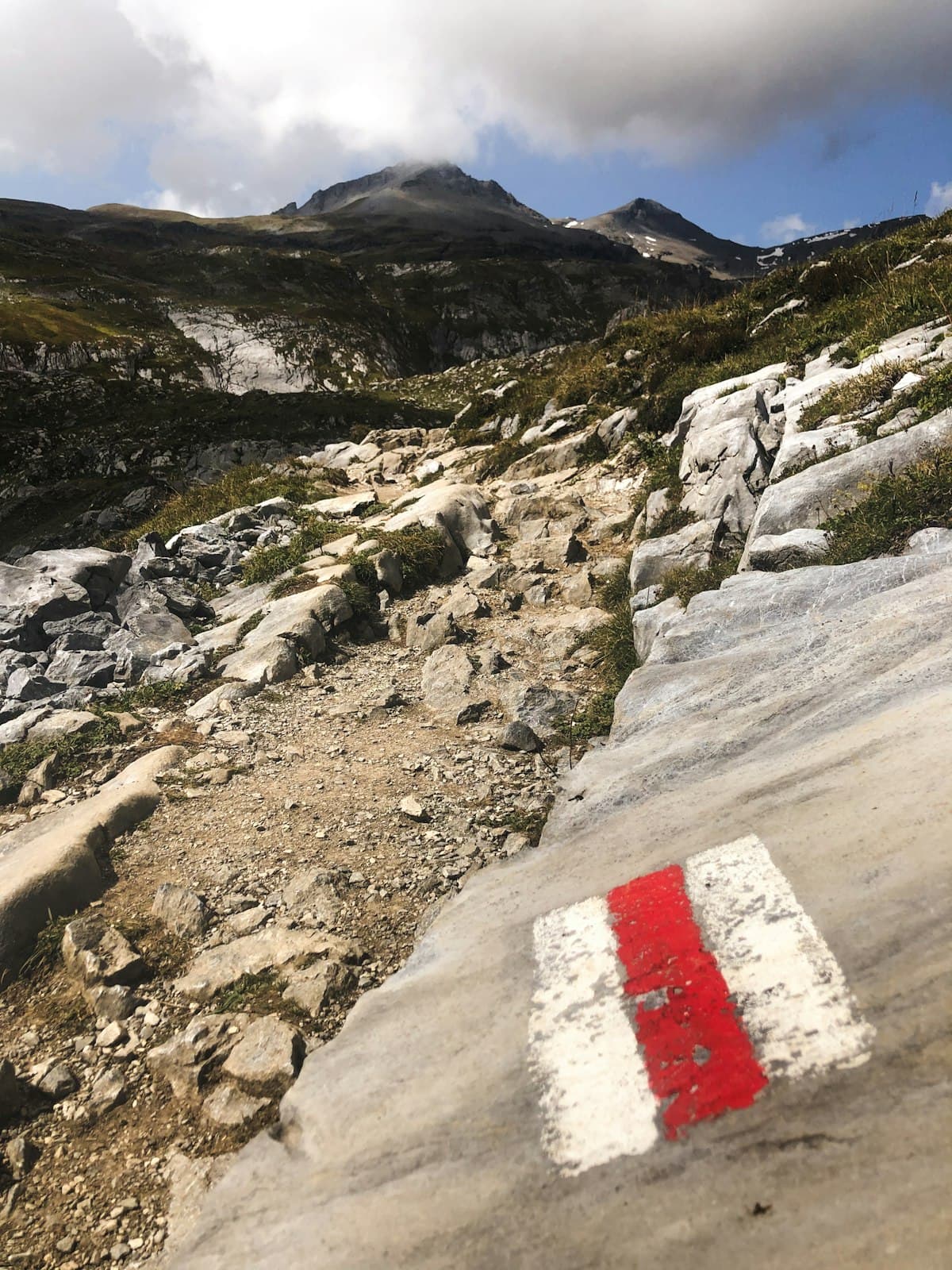
Trail Markings in France: The Complete Guide
You're mid-hike, the trail splits in two, and you spot a red and white mark on a tree, a yellow cross on a rock, a green stripe on a post. What do these signs mean? Should you turn, keep going straight, or head back?
France boasts one of the densest networks of marked trails in Europe: over 180,000 kilometers of paths maintained and signed by passionate volunteers. But you need to know how to read this visual language. This guide explains everything about the different types of trail markings, their colours, shapes, and the logic behind each blaze.
Trail Marking in France: A System Managed by the FFRandonnée
Trail marking in France is primarily organized by the Fédération Française de la Randonnée Pédestre (FFRandonnée, the French Hiking Federation). Founded in 1947, it coordinates a network of over 250,000 volunteer trail markers who maintain and repaint blazes throughout the year.
The system relies on a standardized colour code and set of shapes found across mainland France. Each trail type has its own colours, allowing hikers to instantly identify the nature of the route they're on.
Markings are painted on a variety of surfaces: tree trunks, rocks, posts, stone walls, bollards, and signposts. They are placed at regular intervals to reassure hikers and are reinforced at decision points (junctions and forks).
Grande Randonnée Trails (GR) — Red and White
GR trails are the stars of French hiking. Recognizable by their red and white blazes (two horizontal stripes stacked on top of each other), they cross France over long distances, sometimes spanning several hundred kilometres.
What Is a GR?
A Grande Randonnée trail is a long-distance route designed to be hiked over several days or even weeks. It connects remarkable places — villages, mountain passes, summits, natural sites — and often forms the backbone of a mountain range or region.
Iconic GR Trails
- GR 20: the traverse of Corsica, considered one of Europe's finest treks. 180 km in 16 stages through the Corsican mountains.
- GR 10: crossing the Pyrenees from west to east, from the Atlantic to the Mediterranean. 900 km of pure mountain bliss.
- GR 34: the customs officers' path in Brittany, following the entire Breton coastline for over 2,000 km.
- GR 5: from the North Sea to the Mediterranean, crossing the Vosges, Jura, and Alps.
- GR 9: from the Vosges to the Mediterranean via the Luberon, a trail you can explore with tracks available on OpenRando.
- GR 65: the Way of Saint James from Le Puy-en-Velay.
Reading GR Markings
| Marking | Meaning |
|---|---|
| Two horizontal stripes (red on white) | Right direction, keep going |
| Two stripes forming an angle (red on white) | Change of direction (turn) |
| Two stripes with a cross (red on white) | Wrong direction, do not take this path |
Grande Randonnée de Pays Trails (GRP) — Yellow and Red
GRP trails (or GR de Pays) are loop routes that let you discover a specific region or territory over several days. Their blazes are yellow and red stripes.
Difference Between GR and GRP
Where a GR crosses a long distance in a linear fashion, a GRP forms a loop around a territory. It's designed for an in-depth exploration of a specific area: heritage, gastronomy, and typical landscapes.
GRP Examples
- GRP Tour du Luberon: a 200 km loop around the Luberon massif, through perched villages, lavender fields, and gorges. Find Luberon trails on OpenRando.
- GRP Tour des Monts d'Aubrac: 160 km through the volcanic landscapes of the Aubrac plateau.
- GRP Tour du Queyras: in the heart of the Southern Alps, between high-altitude lakes and larch forests.
Promenade et Randonnée Trails (PR) — Yellow
PR trails are the most numerous and most accessible. Marked with a single yellow horizontal stripe, they offer short routes, generally completed in a few hours or a single day.
PR Characteristics
- Duration: from 1 hour to a full day
- Distance: rarely more than 25 km
- Shape: usually a loop (same start and end point)
- Audience: ideal for families, beginners, or weekend outings
Reading PR Markings
The code is identical to GR trails, but in yellow:
| Marking | Meaning |
|---|---|
| Yellow horizontal stripe | Right direction |
| Yellow stripe forming an angle | Change of direction |
| Yellow cross | Wrong direction |
PR trails are often listed in local topoguides published by regional hiking committees.
Other Types of Trail Markings
Blue Markings
Some regions use blue for local or thematic routes. This isn't an FFRandonnée standard, but you'll encounter it regularly, particularly in southern France and some natural parks.
Green Markings
Green is sometimes used for nature discovery trails, botanical routes, or interpretive circuits in regional natural parks.
Orange Markings
Orange is the standard for cross-country skiing and snowshoe routes in winter, mainly in mountain areas.
Cairns
In high mountains, above the tree line, painted blazes are often supplemented or replaced by cairns: stacks of stones placed at regular intervals. They're essential when snow covers the trail or fog reduces visibility.
Important: never build your own cairns and never dismantle existing ones. They are part of the official trail marking system, and a misplaced cairn can mislead a hiker, with potentially dangerous consequences in the mountains.
How to Read Trail Markings on the Ground
The Three Universal Shapes
Regardless of the trail type (GR, GRP, PR), markings always follow the same shape code:
- Continuous stripe = right direction, keep going straight
- Stripe forming an angle = change of direction, the stripe shows which way to turn
- Cross (×) = wrong direction, turn back or take the other path
Marking Frequency
Under normal conditions, you should see a trail marking at least every 150 to 200 metres. At junctions or tricky sections, markings are placed closer together.
Golden rule: if you walk for more than 10 minutes without seeing a marking, stop and retrace your steps to the last marking you spotted. Then look for the correct fork.
Directional Signposts
At major crossings, directional signposts complement painted blazes. They indicate:
- The trail name and number (e.g., GR 9, PR 42)
- Destinations with estimated walking times
- Sometimes altitude and distance
Park and Reserve-Specific Markings
National Parks
French national parks (Vanoise, Écrins, Mercantour, Calanques, etc.) use standard FFRandonnée markings for GR and PR trails crossing their territory. They sometimes add their own signage with the park logo.
In the core zones of national parks, trails are strictly regulated: it's forbidden to leave the marked trail, pick plants, or camp outside designated areas.
Regional Natural Parks
Regional natural parks may have additional markings for their themed trails (heritage, wildlife, geology). These local markings are usually well documented at park visitor centres and tourist offices.
Common Mistakes to Avoid
Confusing Old Markings with Current Ones
Trails evolve: a route may be rerouted, a GR may be diverted. Old markings sometimes remain on decommissioned sections. When in doubt, trust the freshest markings and check your map.
Following Markings from Another Trail
In areas where several trails cross or overlap, it's easy to accidentally "jump" onto another route. Stay alert to the colour of your trail marking and carefully note the junction points shown on your map or GPS app.
Ignoring Crosses
The cross (×) is a clear stop signal. Yet many hikers ignore it, assuming the path is "still walkable." The result: dead ends, private property, dangerous passages, or wildlife breeding zones.
Complementing Markings with GPS
Trail markings are a reliable system, but they have their limits: in thick fog, snow, or on poorly maintained trails, markings can be invisible or ambiguous.
That's why it's recommended to always carry a GPX track alongside visual markings. With OpenRando, you can download GPX files for thousands of hikes in France and load them onto your phone or GPS watch before setting off.
The combination of visual trail markings on the ground and a GPS track on your device is the best guarantee of never getting lost, even in the most challenging conditions.
Contributing to Trail Maintenance
Trail markings exist thanks to the work of thousands of volunteers. If you notice a faded blaze, a damaged sign, or a toppled cairn, you can:
- Report the issue to the FFRandonnée or your local departmental hiking committee
- Join a volunteer association of trail markers to actively contribute to network maintenance
- Respect existing markings by never altering blazes, cairns, or signposts
Every hiker is also a guardian of the trails. By taking care of markings, you ensure the safety and enjoyment of those who come after you.
Next time you spot a red and white blaze or a yellow stripe on a rock, you'll know exactly what it means. And if you want to plan your next hike with confidence, explore the thousands of GPX tracks available on OpenRando — trail markings and GPS, hand in hand.
Related reading
The 10 Most Beautiful Hiking Villages in France
Gordes, Roussillon, Bonnieux, Lourmarin... Discover the 10 most beautiful villages for hiking in France. OpenRando routes, GPX tracks and practical tips for each destination.
How to Read and Use a GPX File for Hiking
Everything you need to know about GPX files: how to open them, follow them on your phone, and use them to never get lost on a hike.
The Most Beautiful Hikes in Pyrénées-Orientales
Discover the best hikes in Pyrénées-Orientales: from the mythical Canigou to the wild Albères, through the Conflent massif and the Côte Vermeille. Detailed itineraries, tips and gear advice.